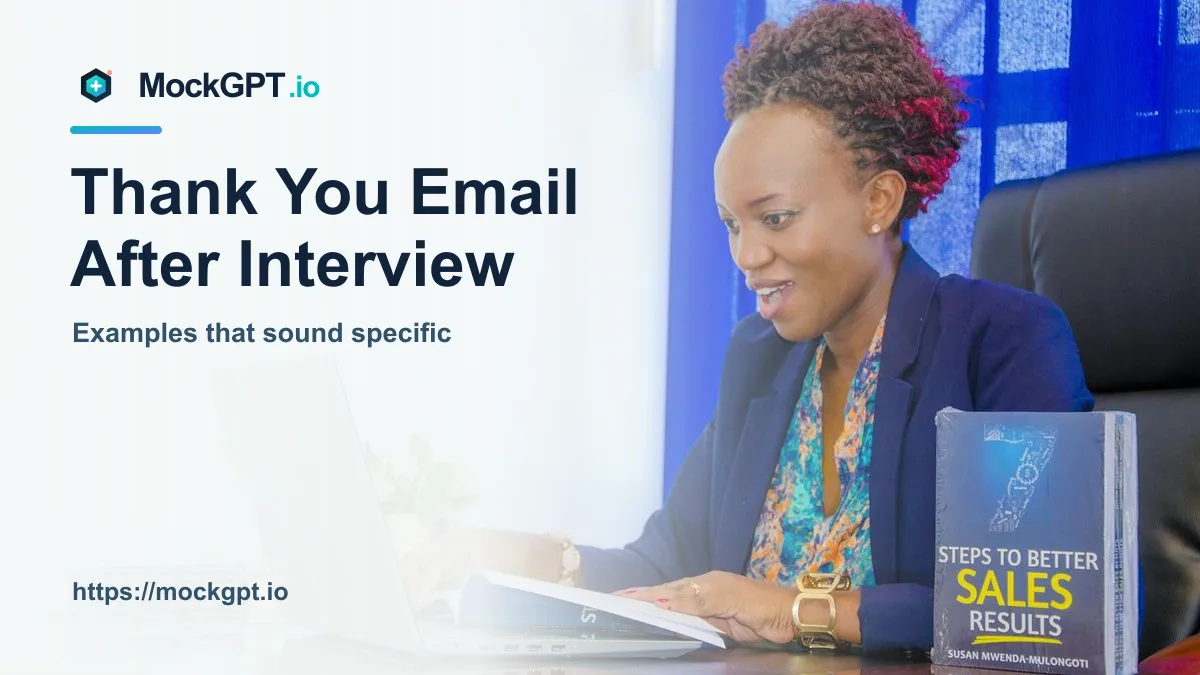
If you are looking for thank you email after interview examples, MockGPT treats the email as one more interview answer: short, specific, and tied to the role. The note should not sound like a greeting-card template. It should remind the interviewer what you discussed, show that you listened, and make it easy for them to remember why your background fits the next step.
The best thank-you email usually has four parts: appreciation, one specific conversation detail, one role-fit sentence, and a clean close. You do not need a dramatic pitch. You need a note that sounds like a thoughtful candidate wrote it within a day of the conversation.
Use thank you email after interview examples as starting points, not scripts. A copied note can make you sound interchangeable. A specific note can reinforce the story you already told in the interview.
Send a thank-you email within 24 hours when you can. Keep it under about 150 words, mention one real detail from the interview, connect that detail to your fit, and close with appreciation.
What to send after an interview
A thank-you note is not a second cover letter. It is a short follow-up that helps the interviewer place your conversation in context. If you talked about a customer migration, mention the migration. If the hiring manager cared about cross-functional handoffs, mention the handoff problem and the way your experience connects.
Generic notes are easy to ignore because they could have been sent to anyone. Specific notes are useful because they show attention. That does not mean you should recap the entire interview. Choose one detail and make it do real work.
The Muse's guidance on interview thank-you notes also emphasizes sending a prompt note and customizing it beyond a boilerplate template. That is the right bar: fast enough to show professionalism, specific enough to sound human.

A simple thank-you email template that does not sound fake
Most thank you email after interview examples fail because they are too polished. They say "I am excited about the opportunity" three different ways and never mention the actual interview. Use a lighter structure instead.
The template below is short enough for a recruiter, but specific enough for a hiring manager. Replace the bracketed parts with real details from your conversation.
Thank-you email structure
Keep the message short, specific, and easy to scan| Email part | What it should do | Example wording |
|---|---|---|
| Subject line | Make the email recognizable | Thank you for your time today |
| Opening | Thank them without overdoing it | Thank you for taking the time to speak with me today. |
| Specific detail | Prove the note is not generic | I appreciated learning more about [team priority]. |
| Fit sentence | Connect one experience to the role | My work on [relevant project] maps closely to that challenge. |
| Close | Leave the next step open and warm | I enjoyed the conversation and look forward to next steps. |
Here is the full shape: "Hi [Name], thank you for taking the time to speak with me today. I appreciated learning more about [team priority], especially the need to [specific challenge]. My experience with [relevant project] feels closely connected to that work, and the conversation made me even more interested in the role. Thanks again, and I look forward to hearing about next steps."
This is why strong thank you email after interview examples feel edited, not inflated. They remove filler and keep the most useful evidence from the conversation.
Thank you email after interview examples you can adapt
Use these examples by interview situation. The point is not to copy the language exactly. The point is to see how each note uses one conversation detail, one fit signal, and one clean close.
Use one line from the actual conversation.
Connect that line to one relevant project or habit.
End warmly without asking for a decision.
Example 1: after a recruiter screen
Subject: Thank you for your time today
Hi Maya, thank you for speaking with me today about the Customer Success Manager role. I appreciated learning more about the team's focus on expansion accounts and the need for someone who can balance renewal risk with consultative support. My experience managing onboarding escalations and turning them into repeatable playbooks feels especially relevant. Thanks again for the conversation, and I look forward to next steps.
Example 2: after a hiring manager interview
Subject: Thank you - Product Operations role
Hi Daniel, thank you for meeting with me today. I enjoyed hearing how the team is trying to make launch decisions clearer across product, support, and sales. The discussion reminded me of the release-readiness checklist I built in my last role, where the main goal was to reduce late surprises without slowing the team down. I am excited about the chance to bring that kind of operating rhythm to this role. Thank you again for your time.

Example 3: after a technical interview
Subject: Thank you for the technical conversation
Hi Priya, thank you for the technical interview today. I appreciated the discussion around debugging production issues and explaining tradeoffs while working under time pressure. The conversation connected well with my experience improving incident notes and post-release monitoring in my current team. I enjoyed the problem-solving style of the interview and would be glad to continue the process.
Example 4: after a panel interview
Subject: Thank you to the team
Hi Jordan, thank you and the team for the thoughtful conversation today. I especially appreciated the questions about stakeholder alignment because that is a real part of the work, not just an interview topic. The panel's focus on making decisions visible across teams made the role more interesting to me. My background in coordinating launches with product, design, and customer-facing teams seems well matched to that environment. Thank you again for everyone's time.
When several people interview you, write down which person cared about which risk. That makes each follow-up note more specific.
Example 5: after a final interview
Subject: Thank you for today's final conversation
Hi Avery, thank you for the conversation today. I appreciated the chance to discuss what success would look like in the first six months, especially the balance between quick wins and building a repeatable process. That is the kind of challenge I have enjoyed in past roles, where the work required both execution and better systems. I remain very interested in the opportunity and appreciate the time you and the team have invested.
If your thank-you email could be sent after any interview, it is too generic. Add one detail that only makes sense after this conversation.
When to send your thank-you email after an interview
Send it the same day if the interview happened in the morning or early afternoon. If the interview ended late, the next morning is fine. The goal is to follow up while the conversation is still fresh, without sending a rushed note full of vague excitement.
If you interviewed with several people, send separate notes when you have each person's email and the conversations were meaningfully different. If the panel was large or the recruiter is managing communication, one note to the recruiter or main contact can be enough. Do not turn follow-up into a chore for the hiring team.
For thank you email after interview examples that go to multiple interviewers, vary the specific detail. One person may have asked about metrics. Another may have asked about team communication. If every note says the same thing, separate emails do not add much value.

Subject lines for a thank-you email after interview
The subject line should be boring in the best way. It needs to be recognizable, not clever. You can use the role name when it helps the interviewer place the conversation.
- Thank you for your time today
- Thank you - [Role Name] interview
- Appreciated our conversation today
- Thank you for the [Team Name] conversation
- Following up after today's interview
Avoid subject lines that sound like a pitch campaign: "One more reason I am perfect for this role," "My follow-up thoughts," or "Why I am the candidate you need." A thank-you note should reinforce trust. It should not feel like pressure.
Mistakes that make a thank-you email weaker
The biggest mistake is over-writing. A long note can make the interviewer re-read your pitch instead of remembering the conversation. Keep the email short enough that a busy person can read it on a phone.
The second mistake is adding new claims you did not support in the interview. If you forgot to mention a relevant project, you can briefly connect it, but do not introduce a whole new story. The note should clarify your fit, not reopen the interview.
The third mistake is sounding desperate. "I really, really hope to be selected" does not help. Neither does asking for feedback before the team has made a decision. Stay warm, specific, and calm.
Add one detail from the actual conversation.
Keep it short enough to read quickly on a phone.
Do not make the email feel like a second pitch deck.
Send it while the interview is still easy to remember.
What to do if you already sent a thank-you email and hear nothing
A thank-you email is not the same as a status follow-up. Give the hiring team the timeline they mentioned. If they said they would respond by Friday, do not follow up again on Wednesday. If no timeline was given, waiting about five business days before a short status check is usually reasonable.
A post-interview follow-up email can be even shorter than the thank-you note: "Hi [Name], I hope you are doing well. I wanted to follow up on the [Role Name] process and see whether there are any updates on next steps. I remain interested in the role and appreciate your time." That is enough.
If you have no response after a second polite follow-up, move your energy back to preparation and other applications. Silence is frustrating, but repeated messages rarely improve your standing. Use the interview notes while they are fresh and prepare for the next conversation.

Use your interview notes before you write the email
Good interview thank you email examples come from good notes. Right after the conversation, write down the role priorities you heard, the hardest question, the strongest answer you gave, and one detail that made you more interested. Those four notes are usually enough to write a specific email.
MockGPT fits this moment because the same material that improves an email also improves the next interview. Resume context, target job description, follow-up pressure, and transcript review all help you notice what the interviewer cared about. If your thank-you email says you are excited about customer migration risk, your next practice round should prepare for follow-up questions about customer migration risk.
That is the difference between a polite note and useful preparation. The email closes the loop with the interviewer. The notes behind it help you prepare for the next loop.
After the interview, capture three details: what they cared about, where you showed evidence, and what you need to prepare next. Then write the thank-you email from those notes.
Bottom line: write a specific note, not a perfect one
The best thank you email after interview examples are simple. They thank the interviewer, mention one real point from the conversation, connect that point to your experience, and close without pressure. The note should sound professional, but it should still sound like you.
When you compare thank you email after interview examples, choose the version that carries the clearest signal from the actual conversation, not the version with the most impressive wording.
Before sending, read it once and ask: could this email only belong to this interview? If the answer is yes, it is probably specific enough. If it sounds like a template, add one detail from your notes and remove one generic sentence. MockGPT can help you turn the same interview notes into better follow-up answers, transcript review, and a clearer next practice round.
FAQ: thank you email after interview examples
What should a thank-you email after an interview say?
A thank-you email after an interview should thank the interviewer, mention one specific conversation detail, connect that detail to your experience or interest in the role, and close with appreciation for next steps.
How soon should I send a thank-you email after an interview?
Send it within 24 hours when possible. Same day is fine after a morning or early afternoon interview; the next morning is fine after a late interview.
Should I send a thank-you email to every interviewer?
Send separate emails when you have each person's address and each conversation had a different focus. If the panel was large or communication goes through a recruiter, one thoughtful note to the main contact can be enough.
How can MockGPT help me write a better post-interview follow-up?
MockGPT helps you turn interview notes, resume context, job description signals, and transcript review into a more specific follow-up email and a clearer next practice plan.