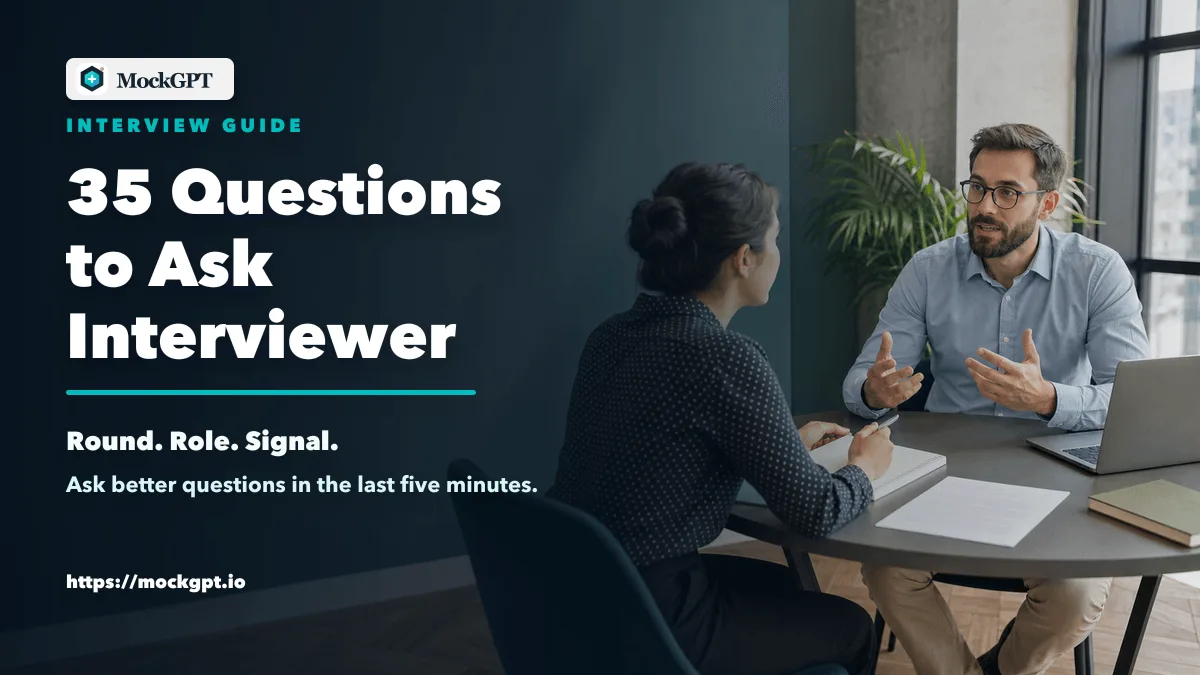
When MockGPT helps you prepare questions to ask interviewer, it treats the last five minutes as part of the interview signal, not a formality. The interviewer smiles, checks the clock, and asks, "What questions do you have for me?" A nervous candidate asks about the next step, says thank you, and leaves. A stronger candidate uses that moment to learn how the role really works.
Good questions to ask interviewer are not clever tricks. They help you understand expectations, risks, team habits, manager style, and whether the opportunity fits your goals. They also show that you have listened carefully instead of waiting for your turn to perform.
MockGPT treats this part of preparation as a signal-gathering skill. You can practice answering questions, but you should also practice asking questions, listening to the answer, and turning what you hear into your next follow-up, thank-you note, or practice plan.
The best questions to ask interviewer connect the job description, the person in front of you, and the decision you need to make after the call. Do not bring one generic list to every round.
Why questions to ask interviewer matter
Candidate questions do three jobs at once. First, they help you decide whether the role is worth pursuing. Second, they show the interviewer that you understand what the role may require. Third, they reveal where your next preparation should go if you advance to another round.
Georgetown's general interview guide makes this two-way nature explicit: candidates are evaluating the employer while the employer evaluates them. Georgetown also recommends asking questions that support a well-informed decision if you receive an offer.
That is why a copied list can fall flat. If you ask a recruiter a deep architecture question, they may not have the context. If you ask a future manager only about office perks, you waste the chance to understand expectations. If you ask a peer about promotion policy, you may get a polite but shallow answer.
Question strategy by interview round
Choose questions by who can answer them well| Round | Best signal to gather | Strong question | Avoid asking |
|---|---|---|---|
| Recruiter screen | Hiring process, role basics, must-have fit. | What are the main signals the team wants from this first round? | Deep team politics or compensation too early. |
| Hiring manager | Success metrics, constraints, priorities. | What would make this hire successful in the first 90 days? | Questions already answered in the job description. |
| Future peer | Collaboration, handoffs, daily reality. | What makes someone easy to work with on this team? | Anything that asks the peer to judge your offer odds. |
| Panel round | Cross-functional expectations. | Where do teams usually need better communication from this role? | The same question repeated to every panelist. |
| Final round | Strategic fit, leadership style, risks. | What problem would you most want this person to help change? | Questions that sound like you stopped evaluating the role. |
- RecruiterClarify process, fit, and hiring signals.
- ManagerAsk about success, priorities, and constraints.
- PeerAsk about collaboration and the daily work.
- Final roundAsk about judgment, direction, and risks.
35 questions to ask interviewer by signal
You do not need all 35 questions to ask interviewer. You need a short, flexible menu. Prepare 8 to 10 before the call because several will be answered naturally. In the interview, ask two to five depending on time, level, and the energy of the conversation.
MIT Career Advising and Professional Development notes that candidates are expected to have several questions ready near the end of an interview, while still respecting that the interviewer is driving the meeting. That balance matters: be prepared, but do not turn the ending into an interrogation.
Role success and expectations
- What would make someone successful in this role in the first 90 days?
- Which part of the role tends to surprise new hires?
- What are the most important problems this person should solve first?
- How will success be measured after six months?
- What separates a good performer from a great performer here?
- What skill or habit would make someone struggle in this role?
- How has the role changed since the job description was written?
Team process and collaboration
- How does this team usually make decisions when priorities conflict?
- Which teams or stakeholders will this role work with most often?
- What does a good handoff look like on this team?
- Where does communication usually break down, and how do strong team members prevent that?
- How does the team handle feedback when work is moving quickly?
- What kinds of meetings or rituals actually help the team move work forward?
- What do you wish candidates understood better about the day-to-day work?

Manager style and support
- How do you like to give feedback to people on your team?
- What does a strong first month with you as a manager usually look like?
- How do you prefer people to raise risks or disagree with a decision?
- What kind of support do new hires usually need most?
- How do you balance autonomy with coaching?
- What are examples of growth you have seen from people in this role?
- What should someone never be afraid to ask you?
Company direction and role risk
- What company or team priority is most likely to shape this role over the next year?
- What constraints should a new hire understand before joining?
- What problem has been harder to solve than the team expected?
- How does this team decide what not to do?
- What does the team need more of right now: speed, quality, experimentation, stability, or alignment?
- Where do strong candidates sometimes misunderstand the opportunity?
- If this hire works out extremely well, what will be different for the team?
Next steps and decision clarity
- What are the next steps in the process?
- What should I prepare for the next round if I move forward?
- Is there anything from our conversation that you would like me to clarify?
- What signals will the team compare after this round?
- When should I expect to hear back?
- Who else would I likely meet in the process?
- Is there anything in my background that you would want me to expand on in the next conversation?
Prepare more questions than you will ask. The strongest questions to ask interviewer are often the ones you adapt after hearing what the interviewer already told you.
Choose questions by who is interviewing you
The same question can be excellent or awkward depending on who receives it. A recruiter can usually explain the process, must-have qualifications, compensation timing, and who owns the next decision. A hiring manager can explain priorities, tradeoffs, performance expectations, and how the role will be judged. A peer can explain daily collaboration, handoffs, and team norms. A senior leader can explain why the role matters strategically.
If you do not know who will interview you, prepare one safe question for each level: process, role success, team collaboration, and next round. Then choose in the moment. This keeps your questions relevant without making you dependent on a perfect plan.
The best questions to ask interviewer also respect what the person can answer honestly. A future peer may not be able to discuss headcount strategy. A recruiter may not know the technical debt inside a product area. A manager may answer compensation details carefully until an offer is active. Aim questions at the person's actual view of the role.
Ask about process, screening signals, logistics, and what to prepare next.
Ask about outcomes, priorities, coaching, and how success will be judged.
Ask about collaboration, team rhythm, handoffs, and everyday friction.
Questions to avoid in a job interview
Some questions create the wrong signal. Avoid asking anything that could be answered by reading the job description, company homepage, or recruiter email. Avoid questions that imply you care only about what the company can give you before you have established fit. Avoid negative questions that put the interviewer on defense, such as "Why do people quit here?"
This does not mean you should avoid hard topics forever. It means timing matters. Salary, benefits, remote policy, relocation, sponsorship, and title level may be important, but they are usually better handled with the recruiter or after mutual interest is clearer. Georgetown specifically cautions candidates not to ask about compensation or benefits until an offer is pending.
There is also a subtle category of questions that sound smart but do not help. "What keeps you up at night?" can work with a senior leader, but it can sound theatrical in a first recruiter screen. "What is your leadership philosophy?" may be useful with a manager, but vague if you do not follow up. Strong questions are concrete enough that the answer changes what you know.
- Do not ask questions already answered in the posting or recruiter email.
- Do not lead with salary, benefits, or vacation in the first conversation unless the recruiter opens that topic.
- Do not ask the interviewer to tell you whether you will get the job.
- Do not ask hostile questions that make the interviewer defend the company.
- Do not ask five unrelated questions when one thoughtful follow-up would be better.
- Do not ask a question you are not willing to listen to closely.
Listen to the answer, then ask the follow-up
Candidate questions are only useful if you listen. When the interviewer answers, listen for signals: vague metrics, clear ownership, repeated constraints, enthusiasm, hesitation, conflicting priorities, or language that matches the job description. The answer tells you what the team values and where the risk may live.
This is where many candidates lose value. They ask a good question, nod, and jump to the next one. Instead, ask one follow-up. If the manager says the first 90 days are about "building trust," ask what trust looks like in practice. If a peer says handoffs can be messy, ask what makes them smoother. If a recruiter says the next round is role-specific, ask which examples you should be ready to discuss.
In a questions to ask at the end of an interview practice loop, you can rehearse this skill by asking your own questions out loud after a simulated answer. That may feel unusual at first, but it trains the habit of turning a generic ending into a real conversation.
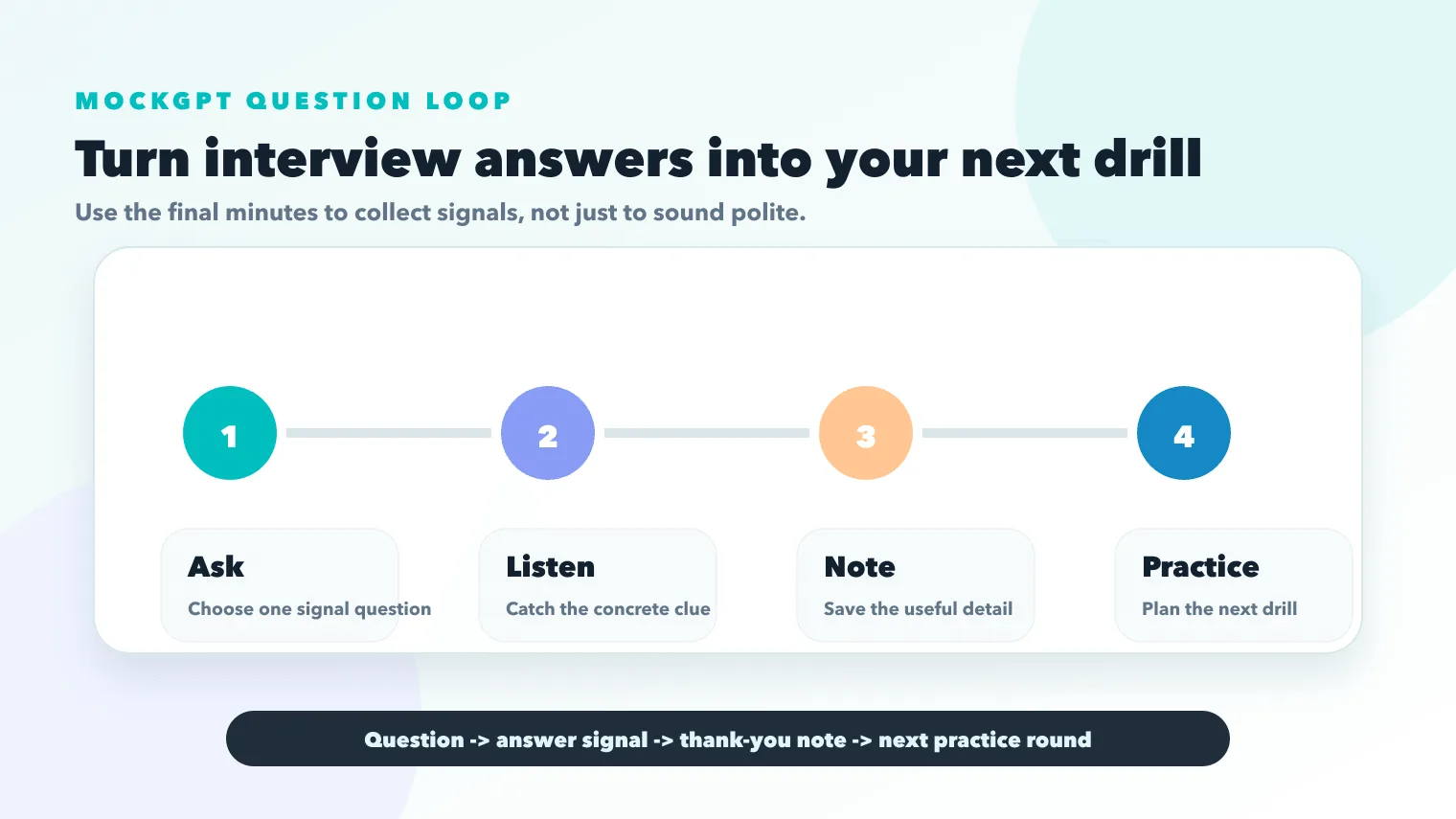
Turn interviewer answers into your next preparation step
After the interview, write down what you learned before the details fade. Do not try to recreate the full conversation. Capture five things: success metric, team risk, interviewer concern, next-round clue, and one question you wish you had asked.
This note helps in two ways. First, it improves your thank-you email because you can reference something specific without sounding generic. Second, it helps you prepare for the next round. If the hiring manager emphasized stakeholder alignment, your next practice session should include a story about influencing without authority. If the peer mentioned quality pressure, prepare a story about tradeoffs between speed and rigor.
NACE's career readiness competencies include communication, critical thinking, leadership, professionalism, and teamwork. Good questions can reveal all of those signals from the employer side too: how people communicate, make decisions, give feedback, manage conflict, and define success.
After-interview note template
Use what you heard to prepare the next round| What you heard | What it may mean | What to practice next |
|---|---|---|
| "We need someone who can bring structure." | The team may be dealing with ambiguity or scattered ownership. | Practice a story about creating process without slowing people down. |
| "Stakeholders move fast here." | Communication and prioritization may matter as much as technical skill. | Prepare a conflict, alignment, or tradeoff example. |
| "The first quarter is mostly learning." | The team may value curiosity and calibration before big changes. | Practice explaining how you ramp up in a new domain. |
| "We are still defining success metrics." | You may need comfort with uncertainty and measurement design. | Prepare a story about choosing useful metrics under imperfect data. |
- Success metricWhat outcome matters first?
- Team riskWhat friction showed up repeatedly?
- Next clueWhat should the next answer prove?
Practice asking questions before the interview
Practicing your own answers is obvious. Practicing your questions is less common, but it changes the ending of the call. Say each question out loud once. If it sounds stiff, shorten it. If it sounds like a challenge, soften it. If it has three parts, split it into one clear question and one optional follow-up.
Also practice the transition. A simple version works: "Yes, I have a few questions. Based on what you shared about the team, I am curious..." That phrase helps you connect your question to the conversation instead of launching into a memorized list.
If you are rehearsing job interview questions to ask, add one ending drill after every mock session: ask two questions, listen to the simulated answer, and write the signal you heard. This makes your preparation more realistic because real interviews are not a monologue. They are a conversation where your questions, follow-ups, and listening all count.
Before your next interview, choose five questions to ask interviewer, say them out loud, and mark which person should receive each one: recruiter, manager, peer, panelist, or final-round leader.
Keep the ending confident and concise
When time is short, do not rush through the whole list. Ask the question that gives you the most useful signal. If the answer opens something important, follow it. A thoughtful follow-up is usually better than a second unrelated question.
End by confirming next steps if they have not already explained them. Then thank the interviewer for their time and connect your interest to something specific from the conversation. This keeps the ending warm, grounded, and useful without sounding like a closing script.
Choose the question that reveals the most useful signal for this round.
Ask one grounded follow-up when the interviewer gives you a real clue.
Turn the answer into your thank-you note and next practice drill.
The practical answer is simple: prepare questions, choose by round, listen for signal, and turn the answer into your next action. Good questions to ask interviewer help you evaluate the role and prepare better for the next conversation.
MockGPT can help you rehearse that full loop with resume-based practice, realistic follow-ups, transcript review, and feedback that points to the next drill.
FAQ: questions to ask interviewer
How many questions should I ask an interviewer?
Ask two to five questions in most interviews, depending on time and how much the interviewer has already covered. Prepare more than you need so you can choose the best fit in the moment.
What are the best questions to ask interviewer at the end?
The best questions ask about success metrics, first priorities, team collaboration, manager style, role risks, and next steps. Choose questions the specific interviewer can answer well.
Should I ask about salary in the first interview?
Usually not unless the recruiter opens the topic or you need to clarify a hard constraint. Detailed compensation, benefits, and negotiation questions are often better after mutual interest is clear.
How can MockGPT help me practice questions to ask interviewer?
MockGPT can help you rehearse the ending of an interview by practicing questions, listening to simulated answers, and turning those signals into a next-round prep plan.