The easiest mistake when learning how to prepare for a job interview is treating the meeting like a quiz, and MockGPT is built around a more realistic practice loop. Candidates collect prompts, write polished paragraphs, memorize the paragraphs, and hope the interviewer asks the exact version they practiced. Real interviews rarely work that neatly. A recruiter may interrupt. A hiring manager may ask for a tradeoff. A panelist may notice a vague phrase on your resume and pull the conversation into a project you barely rehearsed.
That is why learning how to prepare for a job interview is less about memorizing perfect answers and more about building a preparation system. You need to understand the role, choose evidence from your experience, practice saying it out loud, and inspect whether your answer still sounds credible when someone asks a follow-up. The goal is not to become a performer. The goal is to become specific under pressure.
Job interview prep checklist work should connect your resume, the job description, realistic follow-ups, transcripts, replay, and feedback. This guide gives you a practical way to prepare before the interview, then use practice sessions to close the gap between what you know and what you can actually say.
If you are learning how to prepare for a job interview, start with role evidence before you write answers. The job description tells you which stories need to be ready for follow-ups before the real interview call starts.
Start with the job, not with a generic question list
Most people search for common questions first. That can help, but it should not be step one. A stronger process begins with the job description. Read it once for the headline responsibilities, once for the repeated skills, and once for the hidden evaluation criteria. A posting that mentions "cross-functional stakeholders" three times is telling you communication matters. A posting that asks for "ambiguous problem solving" is asking for examples where you made progress without perfect information.
Stanford Graduate School of Business frames interview preparation around researching the role, preparing concise positioning, and choosing persuasive examples with measurable impact. That sequence matters because your stories should be selected for this role, not for a generic version of yourself.
If you are figuring out how to prepare for a job interview this week, make a two-column document. On the left, paste the responsibilities and requirements. On the right, list one experience, project, metric, or decision that could prove each requirement. Do not worry about phrasing yet. At this stage, you are building evidence.
Role-to-evidence map
Use this before writing any answers| Job signal | What it means | Evidence to prepare | Likely follow-up |
|---|---|---|---|
| Own ambiguous projects | They want judgment, not only execution. | A project where scope changed and you chose a path. | What information was missing? |
| Work with stakeholders | They need communication across teams. | A story about conflict, alignment, or tradeoffs. | Who disagreed, and how did you handle it? |
| Data-driven decisions | They expect evidence and measurement. | A metric you influenced or used to make a decision. | How did you know the result was meaningful? |
| Fast learner | They may probe adaptability. | A time you entered a new domain quickly. | What did you do first? |
- Ambiguous projectsPrepare a scope-change story and expect a judgment follow-up.
- Stakeholder workPrepare conflict, alignment, and tradeoff evidence.
- Data-driven decisionsPrepare one metric and why it mattered.
- Fast learnerPrepare a story about entering a new domain quickly.
Build a story bank before you script answers
Once you have the role-to-evidence map, create a story bank. A good story bank is not a collection of full scripts. It is a set of reusable moments: one leadership story, one conflict story, one failure story, one project-impact story, one learning story, one prioritization story, and one story that explains why you want this role.
Each story should include the situation, the stakes, your action, the result, and the lesson. The result does not always need to be a dramatic revenue number. It can be a shipped feature, a resolved customer risk, a cleaner process, a faster reporting loop, or a better team decision. NACE's career readiness competencies emphasize communication, professionalism, teamwork, and leadership as workplace signals; those same signals often appear inside interview evaluation.
This is the point where many candidates over-polish. They try to make every story sound impressive. Resist that. When you learn how to prepare for a job interview, the real skill is choosing stories that can survive detail questions. If your metric is approximate, say it is approximate. If your role was one part of a team effort, be precise about your part. Interviewers trust candidates who know the boundaries of their own contribution.
Practice out loud, then inspect what changed
Writing an answer and saying an answer are different tasks. Writing rewards completeness. Speaking rewards sequence, emphasis, and timing. A written answer can look clear while sounding stiff. A spoken answer can feel natural in your head while losing the listener after twenty seconds. This is why practice must be audible.
Practicing on paper is not enough; the useful part is hearing whether the answer works out loud. Georgetown's general interview guide is a stable reference for how to prepare for a job interview with stronger answer structure and preparation habits.
Record one answer. Then listen without editing yourself. Mark three things: where you became vague, where you gave too much context, and where the result arrived too late. If you use MockGPT, review the transcript after a practice session and compare what you intended to say with what you actually said. That is often where the biggest improvement lives.
If your answer takes more than 90 seconds before the action appears, the interviewer may not understand your contribution.
If you use phrases like "helped with" or "worked on" repeatedly, prepare clearer ownership language.
Use one sentence for context, two or three for action, one for outcome, and one for reflection.
Prepare for follow-ups, not only first questions
Real interviews are interactive. A first answer opens a path. The follow-up tells you what the interviewer is trying to evaluate. If they ask "What did you do personally?" they need ownership. If they ask "Why did you choose that option?" they need judgment. If they ask "What would you do differently?" they need self-awareness.
This is where AI practice can be useful when it is grounded in your resume and target role. You can use role-specific interview preparation to rehearse an answer, get a follow-up, and see whether your story still holds together.
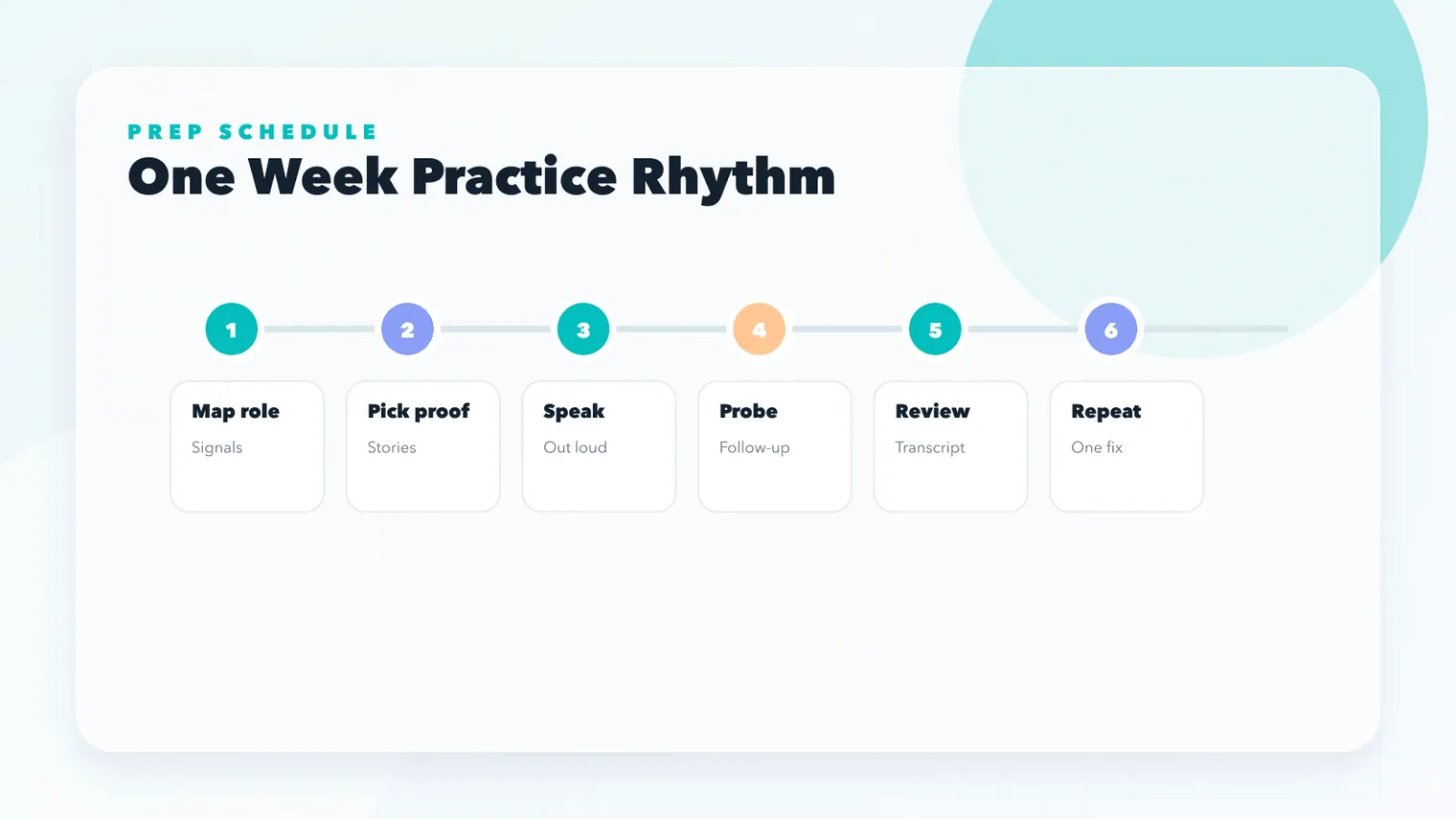
When candidates ask how to prepare for a job interview, they often want a checklist. The better answer is a rehearsal loop. Pick a story, answer once, take the follow-up, review the transcript, and revise only the weak point. Do not rewrite the whole thing every time. Improvement comes from isolating the problem.
- Choose one role signal. Start with a requirement from the job description, not a random prompt.
- Select one story. Use the story that gives the strongest evidence for that signal.
- Answer out loud. Keep the first version conversational, not polished.
- Take one follow-up. Pressure-test ownership, tradeoff, metric, or learning.
- Review the transcript. Fix the exact sentence where the answer became vague.
Make your preparation role-specific
A software engineer, product manager, designer, analyst, marketer, and customer success candidate can all receive "Tell me about a time you handled conflict." The expected evidence will differ. Engineering conflict may involve architecture tradeoffs. Product conflict may involve roadmap priority. Design conflict may involve research interpretation. Customer success conflict may involve retention risk.
That is why how to prepare for a job interview should always include role translation. Ask yourself: what does this question mean for the job I want? If the role requires analysis, bring data. If it requires leadership, bring people decisions. If it requires customer empathy, bring a moment where you changed your plan after learning something from a user or client.
You can explore more role-specific preparation paths as the library grows. Each guide should connect back to the same preparation loop: role signal, story, spoken practice, follow-up, transcript, feedback.
Use the final 24 hours wisely
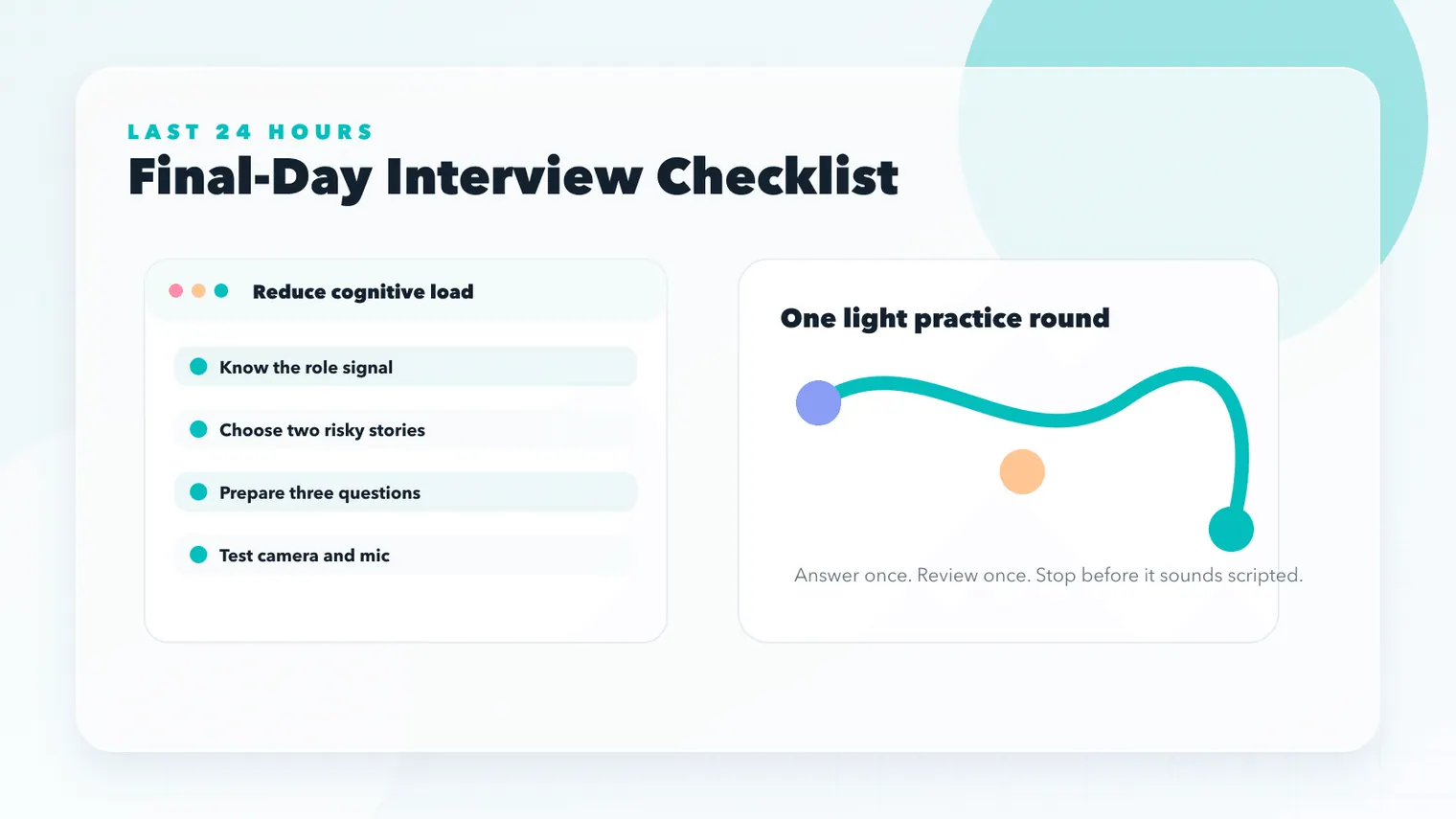
The day before the interview is not the time to rebuild every answer. It is the time to reduce cognitive load. Review the job description, your story bank, your questions for the interviewer, the interview format, and the logistics. If it is virtual, test camera, microphone, lighting, notifications, and browser tabs. University of Colorado Boulder career guidance also recommends reviewing recorded answers after practice.
Then do one light practice round. Choose a story you tend to over-explain. Answer it once. Review it once. Stop. Over-practicing late can make you sound robotic, especially if you keep changing phrasing. Confidence comes from knowing the evidence, not from reciting the same paragraph.
- One-page role-to-evidence map is complete.
- Story bank covers leadership, conflict, failure, impact, learning, and motivation.
- Three questions for the interviewer are prepared.
- Virtual setup has been tested if the interview is online.
- One practice transcript has been reviewed for vague ownership language.
- Follow-up answers are practiced for your two riskiest stories.
What to do after the interview
Preparation does not stop when the call ends. Write down the questions you remember, the stories you used, the follow-ups that surprised you, and any weak answer you want to repair before the next round. If you used practice interview answers before the interview, compare the real questions against your practice transcript. That comparison helps you improve the next session without guessing.
If you are preparing for multiple companies, this after-action review matters even more. One interview may reveal that your project story is too technical. Another may reveal that your motivation answer is too generic. A third may show that your metrics are strong but your setup is too long. The pattern is the useful part.
That is the practical answer to how to prepare for a job interview: build role-specific evidence, practice it out loud, invite follow-ups, review what you actually said, and improve the next repetition. You do not need a perfect script. You need a repeatable system that makes your strongest experience easier to understand.

Prepare differently for each interview round
A recruiter screen, hiring manager round, panel interview, and final conversation are not the same event. They may reuse some prompts, but they usually evaluate different risks. A recruiter wants to know whether your background, motivation, communication, availability, and salary expectations are plausible. A hiring manager wants to know whether you can do the work and explain your decisions. A panel may compare how you think across functions. A final round may test judgment, maturity, and mutual fit.
This matters because candidates waste time practicing every answer at the same depth. For a recruiter screen, you need a crisp story about who you are, why the role makes sense, and which parts of your experience match the job. You do not need a five-minute project walkthrough unless asked. For a hiring manager, you need the deeper project walkthrough: constraints, decisions, tradeoffs, metrics, and what you learned. For a final round, you may need a broader narrative about how you work, what you value, and where you want to grow.
Use your story bank differently by round. Put a star next to the stories that prove basic fit. Put a second mark next to the stories that prove depth. Put a third mark next to the stories that show judgment and reflection. Then rehearse the same story at three levels of detail: thirty seconds, ninety seconds, and three minutes. This prevents you from over-answering simple prompts or under-answering deeper ones.
If the same story cannot be told briefly and deeply, it is probably not ready. Practice a compact version for recruiter screens and a richer version for hiring manager follow-ups.
Plan your questions for the interviewer
Candidate questions are part of preparation, not a polite ending. Good questions show that you understand the role and care about the work. They also help you decide whether the opportunity fits you. A weak question asks for information that was already in the job description. A stronger question asks how success is measured, what the team has learned recently, what constraints shape the role, or what the interviewer believes a great hire would improve first.
Prepare more questions than you expect to use. Interviews often answer some of them naturally. Keep questions grouped by theme: role expectations, team process, company direction, manager style, and next steps. If the conversation already covered team process, choose a question about success metrics. If the interviewer is senior, ask about strategy or tradeoffs. If the interviewer is a potential peer, ask about collaboration and handoffs.
Your questions should also connect to your story bank. If you have a strong example about improving a process, ask how the team currently handles process improvement. If you have a strong customer story, ask how the team gathers customer feedback. This creates a natural bridge between curiosity and evidence without forcing another pitch.
Prepare for answers that go wrong
Even strong candidates give messy answers. The important skill is recovery. If you realize you are rambling, stop and summarize: "Let me make the key point more directly." If you misunderstood the question, ask to reset: "I may have answered the process part more than the decision part; would it help if I clarified the tradeoff?" If you do not know an answer, say what you would check, who you would ask, or how you would reason through it.
Recovery sounds better when practiced. Add one recovery drill to your preparation: answer a question badly on purpose, then practice a clean correction. This may feel awkward, but it builds calm. Interviewers do not expect every sentence to be perfect. They do notice whether you can recognize confusion and repair it.
In a MockGPT session, use follow-ups to practice recovery. When the AI interviewer asks for a missing detail, do not defend the first answer. Treat the follow-up as useful information. The skill you are building is not only answer quality; it is conversational repair under pressure.
Practice one reset sentence before the interview: "Let me make the key point more directly." It gives you a clean way back when an answer starts to wander.
Keep preparation human
There is a difference between being prepared and sounding packaged. Prepared candidates know their evidence. Packaged candidates try to control every sentence. The first style builds trust; the second can make the interviewer feel like they are hearing a recording. Use structure to stay clear, but leave room for natural language.
A simple way to test this is to practice the same answer twice without trying to repeat the exact words. If the evidence, sequence, and result stay stable, you know the story. If the answer falls apart unless you recite it, you have memorized phrasing rather than understanding the story. That is fragile preparation.
Before the interview, remind yourself of the role signal each story proves. That is enough. You do not need to remember every adjective. You need to remember the situation, the action, the result, and the reason it matters for this job.
Make a light practice schedule
If you have a week, avoid cramming all practice into one long session. Use shorter sessions with different goals. On day one, map the role and build the story bank. On day two, practice the recruiter screen basics: introduction, motivation, role fit, and questions for the interviewer. On day three, practice behavioral stories. On day four, practice the technical, functional, or portfolio examples most relevant to the role. On day five, run a realistic mock interview with follow-ups. On day six, review the transcript and fix the two weakest answers. On the final day, do a light refresh and stop early.
If you have only one day, compress the same sequence. Spend the first hour on the job description and story bank. Spend the second hour practicing the highest-risk stories. Spend the third hour reviewing one transcript and preparing questions for the interviewer. Do not spend the whole day reading advice. The work that changes performance is speaking, reviewing, and revising.
This schedule keeps preparation active. Reading lists can make you feel productive while avoiding the uncomfortable part: hearing your own answer and improving it. A short, honest practice loop beats a long passive research session.

Know what not to prepare
Preparation also means deciding what to ignore. Do not prepare twenty versions of the same answer. Do not write a script for every possible question. Do not collect advice from ten sources if it makes you change your approach every hour. Do not over-optimize small details while your main stories still lack evidence.
Focus on the questions that would materially affect the decision. Can you explain why this role? Can you prove the top job requirements? Can you discuss a conflict or failure maturely? Can you ask informed questions? Can you handle one follow-up without panicking? If those are ready, you are in a much stronger position than someone with a beautiful but brittle answer document. A focused MockGPT session can help you check those essentials without turning preparation into another giant list.
FAQ: how to prepare for a job interview
How early should I start preparing?
Start as soon as the interview is scheduled. Even two focused sessions can help: one to map the role and choose stories, and one to practice out loud with follow-ups.
Should I memorize answers?
No. Memorize the structure and evidence, not the full wording. Real interviews change direction, and memorized answers often break when the interviewer asks for detail.
What should I practice first?
Practice the stories most likely to be tested by the job description: impact, conflict, decision-making, learning, and motivation for the specific role.
How can MockGPT help me prepare for a job interview?
MockGPT can connect your resume and target job description to realistic practice questions, follow-ups, transcript review, and feedback so preparation stays role-specific.