Behavioral interview questions sound simple until you are in one, and MockGPT treats them as story pressure tests rather than memory prompts. The interviewer asks for a time you solved a problem, influenced a teammate, missed a deadline, handled conflict, or learned from failure. You know you have examples. Then the question lands, your mind jumps between projects, and you either give too much background or choose a story that does not prove the skill they wanted.
The reason this format is hard is that it evaluates evidence, not opinions. Saying "I am collaborative" is weak. Describing a moment when collaboration changed the outcome is stronger. A good story lets the interviewer infer how you work when the situation is messy, political, rushed, ambiguous, or high stakes.
A strong behavioral interview practice loop works like this: choose a story, answer out loud, handle follow-ups, review the transcript, and revise the story until your ownership and impact are clear. This guide shows how to prepare for behavioral interview questions without turning yourself into a scripted candidate.
Behavioral interview questions are not asking for a polished memory. They are asking for a specific moment that proves how you acted when the work became difficult, ambiguous, or high stakes.
What behavioral interview questions are really testing
A behavioral interview asks you to describe past behavior so the interviewer can assess likely future behavior. MIT Career Advising explains that behavioral interviewing uses specific examples of past behaviors or skills to evaluate a candidate.
The format is not only for entry-level candidates. Senior candidates get behavioral questions too, but the expected evidence changes. A new graduate may be evaluated on teamwork, learning, and communication. A senior product manager may be evaluated on prioritization, stakeholder conflict, and judgment under uncertainty. A staff engineer may be evaluated on technical leadership, mentoring, and tradeoff decisions.
If you are preparing for a behavioral interview, start by translating each job requirement into behaviors. "Own roadmap execution" becomes prioritization, alignment, and follow-through. "Operate in ambiguity" becomes decision-making without perfect data. "Mentor others" becomes coaching, feedback, and raising team standards.
Behavioral signal map
Turn job requirements into story evidence| Signal | Story type | What to prove | Follow-up risk |
|---|---|---|---|
| Leadership | A decision that changed team direction. | You influenced without relying only on authority. | Who resisted, and why? |
| Conflict | A disagreement with a teammate or stakeholder. | You listened, reframed, and moved toward a decision. | What did you compromise? |
| Failure | A missed goal or flawed decision. | You took responsibility and changed behavior. | What would you do differently? |
| Problem solving | A messy issue with incomplete information. | You structured the problem and tested a path. | What alternatives did you reject? |
- LeadershipShow influence, resistance, and the decision path.
- ConflictShow listening, reframing, and resolution.
- FailureShow ownership, learning, and changed behavior.
- Problem solvingShow structure, alternatives, and evidence.
Build stories around decisions, not job duties
Many weak answers are just job summaries. "I worked with marketing and engineering to launch a dashboard" does not yet prove much. The interviewer needs to hear the decision you made, the constraint you faced, and the result of your action. What was hard? What did you choose? What happened because of that choice?
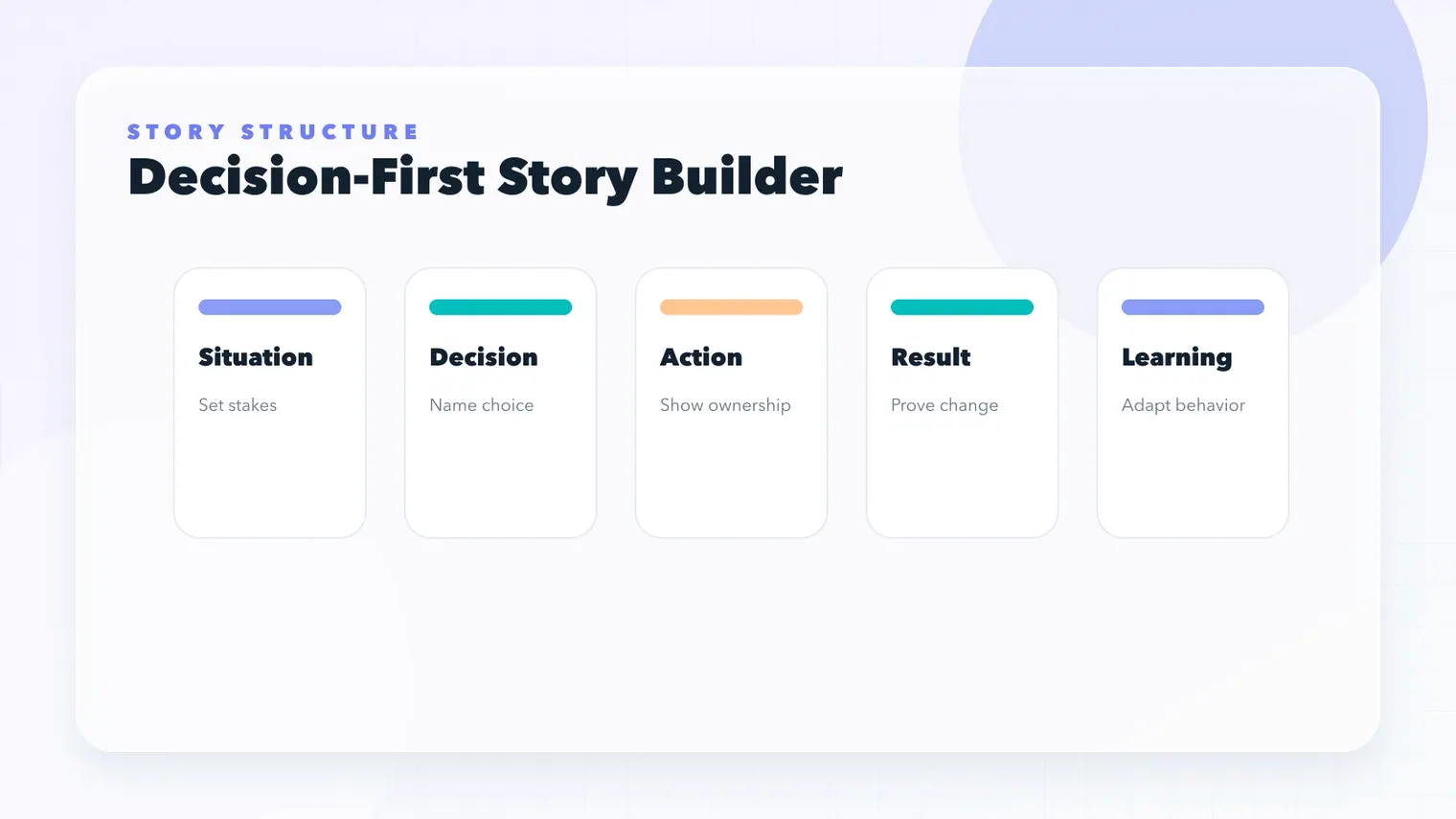
The University of Pennsylvania describes the STAR technique as a way to keep behavioral interview answers focused and reduce rambling. STAR is useful, but it can become mechanical if every answer sounds like a worksheet. The better version is story-first, structure-second.
For each story, write one sentence for the situation, one for the task or stakes, two or three for your actions, one for the result, and one for the lesson. Then remove anything that does not help the interviewer evaluate the behavior. A behavioral interview answer should feel like a real conversation, not a case study read aloud.
Choose evidence that matches the level of the role
The same question can have different expectations by level. "Tell me about a time you handled conflict" for an intern might be about working through a class project. For a manager, it may be about resolving competing priorities across teams. For a director, it may be about changing incentives or making a decision that disappointed one group.
NACE's career readiness competencies can help early-career candidates identify the behaviors employers often value, including communication, teamwork, professionalism, leadership, and career development. More experienced candidates can still use the same categories, but they should choose higher-stakes examples.
If you are using MockGPT, upload or summarize the target job description before practicing behavioral interview questions. The behavioral interview stories you choose should help you understand what might be asked, but the best story choice depends on the role. For a product manager role, your prioritization story may matter more than your teamwork story. For customer success, your escalation story may matter more than your project-launch story.
Use stories that prove reliability, learning speed, teamwork, and communication.
Use stories that prove independent judgment, measurable impact, and cross-functional ownership.
Use stories that prove strategic tradeoffs, influence, coaching, and decisions under uncertainty.
Practice the follow-ups before they surprise you
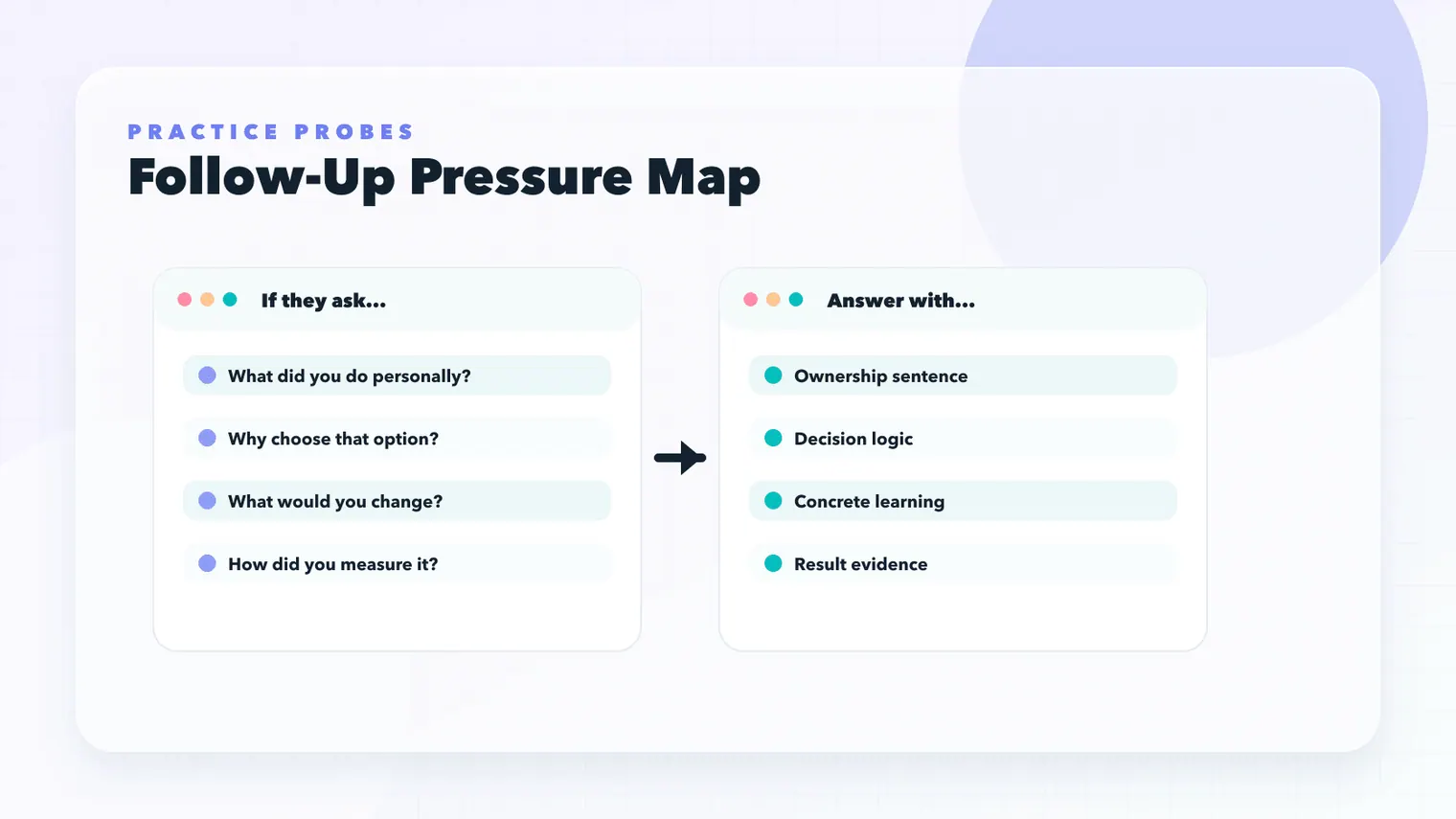
A strong first answer is only the start. The follow-up is where many candidates lose clarity. If the interviewer asks what you personally did, do not repeat the team outcome. If they ask why you chose one path, do not list every possible factor. If they ask what you learned, do not give a motivational slogan. Give the decision logic.
Harvard Catalyst's interview guidance notes that behavioral interview questions ask candidates to describe scenarios where they used skills or navigated situations, and it also emphasizes listening, presence, and natural pauses. That is a useful reminder: a follow-up is not an attack. It is a request for the missing signal.
In MockGPT, the follow-up practice is the product's most important behavior. The AI interviewer should not simply move to the next question. It should notice ambiguity and ask for clarification. If you want a more product-led routine for behavioral interview questions, start from the interview follow-up questions and use the transcript to identify where your follow-up answer became vague.
- Answer the original prompt. Give a complete story, but keep it concise.
- Ask what signal is missing. Ownership, metric, decision logic, conflict, or learning?
- Answer the follow-up in two sentences. Do not restart the whole story.
- Review the transcript. Highlight the first vague phrase.
- Rewrite only that phrase. Keep the rest of the story stable.
Common behavioral interview mistakes
The first mistake is choosing a story because it sounds impressive rather than because it fits the question. A big project is not always the best evidence. Sometimes a smaller story shows clearer ownership. The second mistake is hiding the conflict. If everything sounded easy, the interviewer cannot see your judgment. The third mistake is using "we" for everything. Teamwork matters, but your role still needs to be visible.
Another mistake is ending with the result but not the learning. A behavioral interview often tests self-awareness. If you only describe what happened, you may miss the chance to show how your behavior changed. Add one final sentence: "Since then, I..." That sentence can turn a decent answer into a credible growth story.
- Each story maps to one job requirement or evaluation signal.
- The answer includes a real constraint or conflict.
- Your personal action is clear and not hidden inside "we."
- The result is specific enough to be believed.
- The lesson explains how your future behavior changed.
- You have practiced at least one follow-up for every risky story.
How to use a transcript after behavioral interview questions
A transcript makes the gap visible. You may think your story showed leadership, but the transcript may reveal that you spent most of the answer describing the background. You may think your failure answer sounded mature, but the transcript may show that you blamed timing, tooling, or another team. You may think your result was clear, but the transcript may show no measurable outcome at all.
Read the transcript like an interviewer. Underline the sentence where the behavior appears. If you cannot find it, the story is not ready. Underline the result. If it is too vague, add evidence. Underline the learning. If it sounds generic, make it concrete. This is why transcript review is so useful for behavioral preparation: it separates intention from delivery.
A behavioral interview does not require perfect stories. It requires believable stories that match the role. When your examples are specific, your action is visible, and your follow-ups stay calm, you become easier to trust.
If the behavior, result, or learning is hard to underline, the story needs one clearer sentence before you practice it again.
Prepare stories for negative prompts
Many candidates prepare success stories and avoid negative prompts until the last minute. That is risky. Behavioral interview questions about failure, weakness, conflict, missed deadlines, difficult feedback, and disagreement are common because they reveal self-awareness. The interviewer is not looking for a flawless person. They are looking for someone who can notice a problem, take responsibility, and change behavior.
A strong negative story has three parts. First, it gives enough context to make the issue real. Second, it names your part without blaming everyone else. Third, it explains the change you made afterward. The change is the point. If the story ends with "and then everything was fine," it may sound shallow. If it ends with "since then, I changed how I scope projects," it sounds more credible.
Do not choose a fake weakness or a humblebrag. "I care too much" is not useful. A better answer might explain that you used to wait too long before escalating timeline risk, then describe a project where that created pressure, and then show the new checkpoint system you use now. Specificity makes maturity visible.

If your failure story makes you look good at every moment, it probably does not show learning. Choose a story where the mistake is real but bounded, and where the change afterward is concrete.
Adapt stories by function
A story does not have the same meaning in every function. For engineering, the interviewer may care about technical tradeoffs, reliability, debugging, and collaboration with product or design. For product management, the same story may need to highlight prioritization, customer evidence, stakeholder alignment, and launch impact. For design, it may need to show research interpretation, critique, accessibility, and constraints. For data, it may need to show assumptions, metric quality, and decision influence.
Take one story and rewrite the emphasis for the role you want. Keep the facts the same, but change the lens. A cross-functional launch can be a leadership story, a conflict story, a metrics story, or a learning story depending on what the interviewer asks. This flexibility is more useful than preparing twenty unrelated examples.
Role-based behavioral interview practice is built around this idea. The product should not ask every candidate the same generic prompt. It should use the resume and job description to decide which behavior matters and then ask follow-ups that test whether the story has enough detail.
Handle follow-ups with precision
Follow-ups are usually shorter than the original answer. Candidates often make them longer because they feel exposed. Try the opposite. If the interviewer asks "What did you do personally?" answer in one or two sentences. If they ask "How did you measure success?" name the metric and why it mattered. If they ask "What would you do differently?" explain one specific change.
The best follow-up answers do not restart the story. They zoom in. Imagine the interviewer has placed a finger on one sentence and asked you to clarify it. Your job is to clarify that sentence, not to retell the whole project. This keeps the conversation efficient and makes you sound grounded.
When reviewing a practice transcript, mark every follow-up answer separately from the first answer. A first answer may be strong while a follow-up is weak. That tells you the story is good but the detail layer is not ready. Drill the detail layer.
A follow-up should zoom in, not restart the entire story. Answer the missing detail in two sentences, then let the interviewer choose the next path.
Use a story bank without sounding rehearsed
A story bank is a preparation tool, not a script library. Write short notes: prompt fit, situation, action, result, lesson, and likely follow-up. Avoid full paragraphs unless you are using them only for early thinking. The more you polish a written paragraph, the more tempting it becomes to recite it.
Practice by speaking from notes, then gradually remove the notes. In the first round, use the story bank. In the second, use only the story title. In the third, answer from memory. If the structure survives, the story is ready. If it collapses, the story needs clearer anchors.
The final test is whether you can answer a related but different prompt. If your conflict story also works for a prioritization prompt, you understand the story deeply. If it only works for one exact wording, it is too scripted.
Use examples that show a before and after
Strong stories usually contain a visible before and after. Before, the team was blocked, the process was slow, the customer was frustrated, the data was messy, or the decision was unclear. After, something changed because of your action. The change does not need to be heroic. It needs to be understandable.
Before-and-after framing helps because it gives the interviewer a way to measure the story. If the before state was vague, the result will feel vague too. Instead of saying "the process was inefficient," explain what inefficiency looked like: duplicated work, unclear ownership, slow handoffs, missed bugs, customer confusion, or low adoption. Then the result can be specific even when you do not have a perfect metric.
This is especially useful for candidates who worry they lack dramatic achievements. A small operational improvement can be a strong answer if the before state is concrete, your decision is clear, and the after state shows real improvement. Interviewers are not only looking for huge wins. They are looking for evidence that you notice problems and improve the system around you.
Balance humility with ownership
Some candidates understate their work because they do not want to sound arrogant. Others overstate their work because they want to sound impressive. The strongest answers sit between those extremes. They acknowledge the team while making your contribution legible.
Use language like "the team goal was," "my part was," and "the decision I owned was." This lets you be fair to collaborators without disappearing from your own story. If the interviewer wants more team context, they can ask. If they want more detail about your contribution, you have already opened the door.
Humility without ownership sounds passive. Ownership without humility sounds inflated. A strong story says what happened, who was involved, what you did, and what changed. That is enough.
Name the shared goal so collaboration is visible.
Name the decision, action, or judgment you owned.
Name what became better after the work.
Practice with role-specific interruptions
Most practice sessions let candidates finish every answer. Real interviews often interrupt. A hiring manager may stop you to ask about a metric. A recruiter may ask you to shorten the story. A panelist may challenge an assumption. If you only practice uninterrupted stories, interruptions can feel like failure.
Add interruption drills. Start an answer, then ask yourself a mid-story follow-up: "What was your role?" "Why did that metric matter?" "What was the tradeoff?" "Who disagreed?" "What would you do differently?" Practice answering the interruption without losing the thread. Then return to the original point in one sentence.
This builds conversational flexibility. You are not trying to control the interview. You are learning to stay clear when the interviewer changes the path.
Create a final story shortlist
As the interview gets closer, reduce the story bank instead of expanding it. Choose the five stories you are most likely to use. For each one, write the prompt types it can answer, the role signal it proves, the metric or outcome, and the follow-up you most expect. This shortlist is easier to remember than a large document.
Do one final pass for overlap. If three stories all prove teamwork but none proves judgment, replace one. If all your stories come from the same project, add variety. If every story has a strong action but weak result, collect the outcome evidence before practicing again.
The shortlist should make you calmer. It tells you that you have enough material for the most likely paths. You may still get a surprise question, but surprise questions are easier when your strongest examples are already organized in your mind.

End practice before you flatten your voice
There is a point where repetition makes answers worse. You start chasing perfect wording, your voice becomes flat, and every answer begins to sound the same. Stop before that happens. The final session should refresh confidence, not drain it.
A good stopping rule is simple: once you can tell the story clearly twice without notes, move on. If you keep practicing after that, change the drill rather than repeating the same prompt. Try a shorter version, a follow-up, or a role-specific interruption. Variety protects natural delivery.
Use the last few minutes to review evidence, not wording. Read the story titles, the outcomes, and the likely follow-ups. Then close the document. The interviewer does not need your most literary answer. They need a clear example, a believable decision, and a candidate who can stay present in the conversation.

If you still feel underprepared, choose one story and strengthen the evidence rather than opening a new topic. Add the metric, clarify the stakeholder, or name the decision. Depth on one important example usually helps more than shallow coverage of five extra prompts, and a short MockGPT follow-up round can show whether that stronger evidence survives a real interruption.
FAQ: behavioral interview preparation
How many stories should I prepare?
Prepare six to eight flexible stories: leadership, conflict, failure, impact, learning, prioritization, teamwork, and motivation. One story can often answer more than one prompt.
Is STAR always the best structure?
STAR is a useful baseline, but do not force it mechanically. The best structure is the one that makes the stakes, action, result, and lesson easy to follow.
What if I do not have a big example?
Use a smaller example with clear ownership. Interviewers often prefer a believable, specific story over an inflated story with unclear details.
How can MockGPT help with behavioral interview practice?
MockGPT can use your resume and target role to ask behavioral follow-ups, then help you review whether each story has clear stakes, ownership, result, and relevance.