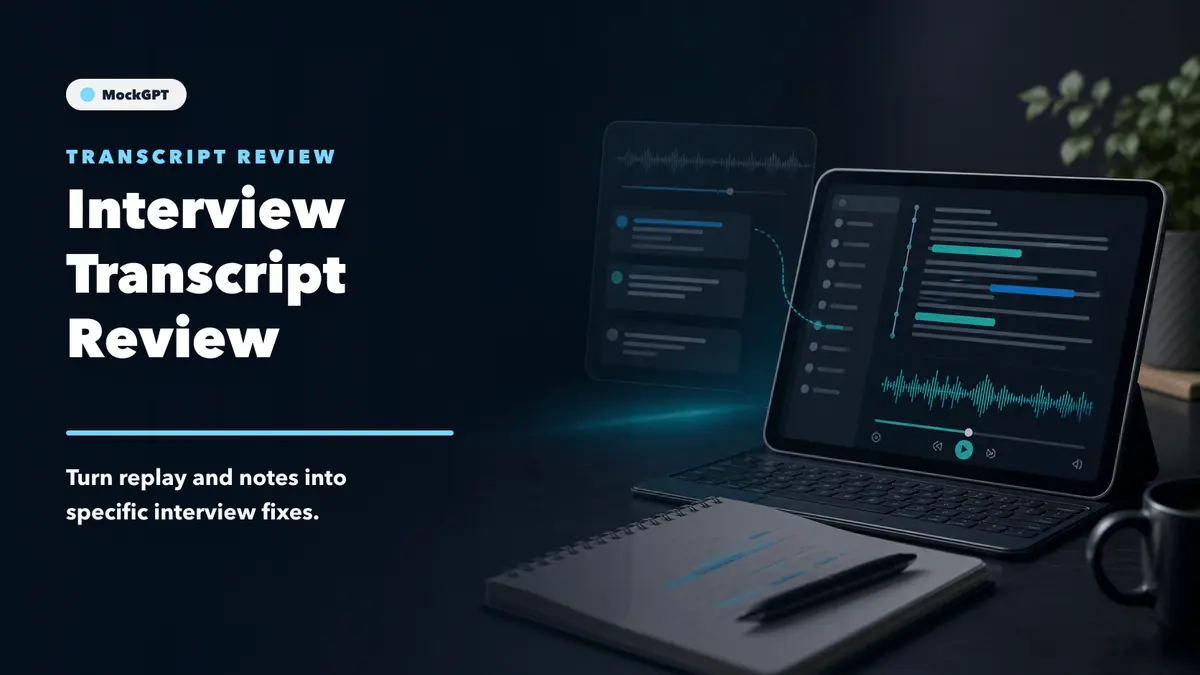
An interview transcript is not just a written record of what happened, and MockGPT treats interview transcript review as the mirror that makes practice honest. It shows the filler phrases you did not notice, the story setup that ran too long, the ownership language that sounded weaker than you intended, and the answer that never quite reached the result. For interview transcript review, that mirror is often more useful than a score.
Most candidates review practice by memory. Memory is generous. It smooths over pauses, compresses rambling, and preserves what you meant to say rather than what you actually said. A transcript is less forgiving, which is exactly why it helps. It turns a vague feeling like "that answer was messy" into something you can edit.
Interview transcript review works best as part of the practice loop: answer, follow up, review, improve, and try again. This guide explains how transcript review works without making you self-conscious, how to mark the most important moments, and how to turn review into better answers.
An interview transcript gives you evidence, not a feeling. Use it to find the exact sentence where your answer became clear, vague, too long, or unsupported.
Why interview transcript review changes practice
When you read an interview transcript, you see sequence. Did you answer the question first, or did you explain the background first? Did your result arrive early enough? Did you use one example or blend three examples together? Did you name the decision you made, or did you imply it?
University of Colorado Boulder career guidance recommends reviewing recorded answers and getting input from others after practice. That advice is especially useful for video and phone interviews, where pacing, clarity, and energy are harder to judge in the moment.
The transcript adds a second layer to recording. Video shows delivery. Audio shows tone. The text shows structure. If you want to improve quickly, use all three, but start with text because it is easiest to mark.
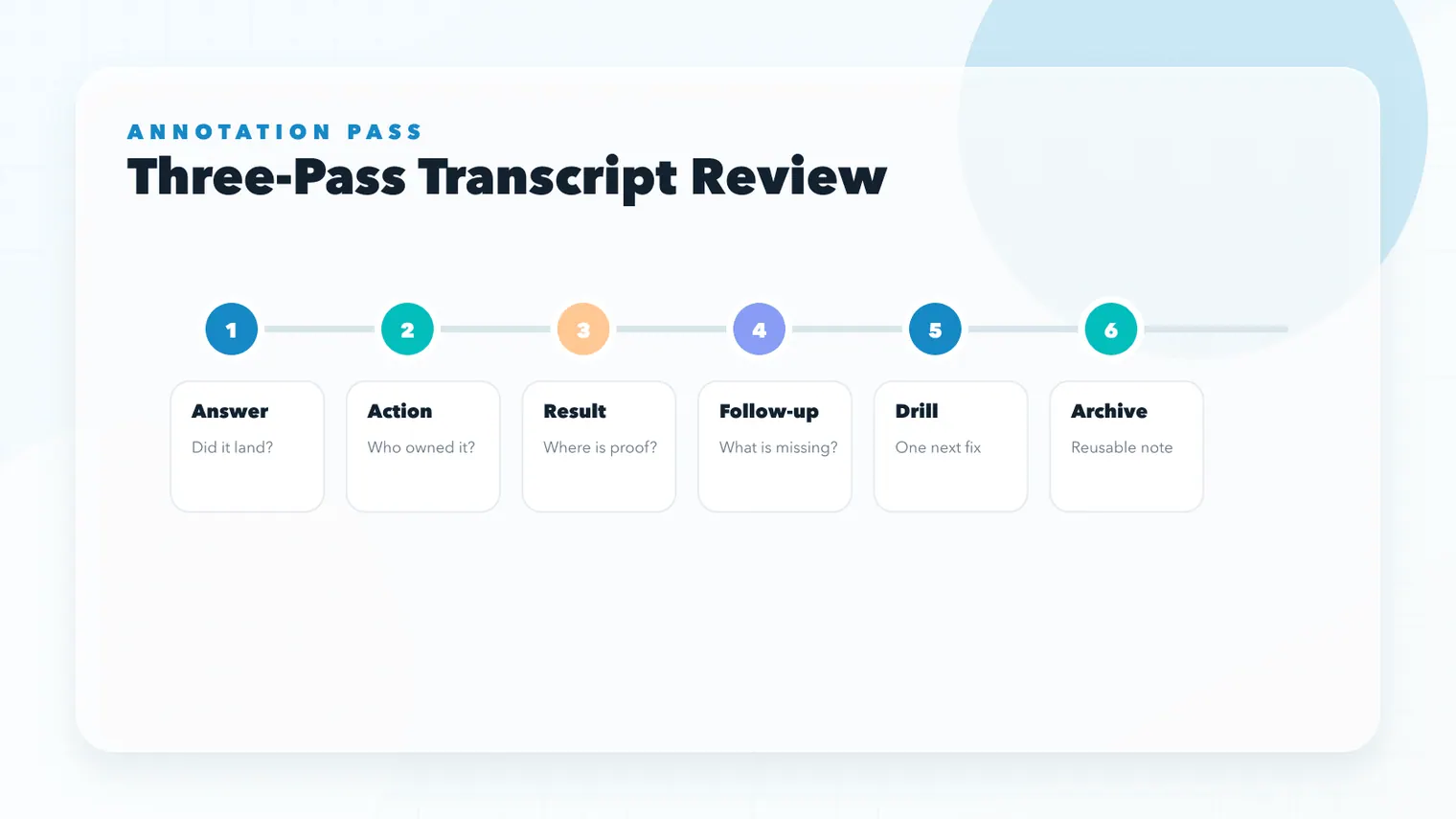
Read the transcript like an interviewer
The first pass should not be emotional. Do not grade yourself. Do not rewrite every line. Read the interview transcript as if you were a busy hiring manager trying to answer four questions: What was the situation? What did the candidate do? What changed because of it? What did they learn?
Georgetown University's general interview guide explains several interview formats, including recorded interviews, behavioral interviews, and phone or video interviews. It also notes that interviewers may pause to take notes. That is useful context because your spoken answer needs to be easy to capture.
In a transcript, your first job is to find the quotable sentence. That does not mean a clever line. It means the sentence an interviewer could write down as evidence: "I reduced weekly reporting time by four hours by consolidating three dashboards into one source of truth." If the transcript does not contain a sentence like that, the answer needs sharper evidence.
Transcript markup system
Use four passes instead of editing everything| Mark | Look for | Meaning | Revision |
|---|---|---|---|
| Setup | Background before action. | The interviewer may be waiting too long. | Cut context to one sentence. |
| Ownership | "We" language without your role. | Your contribution is unclear. | Add one "I owned..." sentence. |
| Outcome | Result, metric, decision, or learning. | This is the proof point. | Move it earlier if buried. |
| Follow-up gap | Question you partly avoided. | The answer missed a signal. | Prepare a two-sentence clarification. |
- SetupTrim background until action arrives sooner.
- OwnershipReplace vague "we" phrasing with precise contribution.
- OutcomePull the proof point toward the middle of the answer.
- Follow-up gapPrepare a concise clarification instead of restarting.
Do not clean the transcript too early
It is tempting to polish every phrase. That can be counterproductive. Spoken language is not written language. A few pauses, restarts, and informal phrases are normal. The goal of interview transcript review is not to make yourself sound like an essay. It is to make your answer easier to understand.
Northwestern Career Advancement recommends reflecting after interviews and adapting notes to the actual conversation. That same habit applies to practice. Review what happened, not what you hoped happened.
In MockGPT, keep the first transcript raw. Highlight weak points, but do not rewrite the entire answer. Then answer again. The second transcript should show one improvement: shorter setup, clearer ownership, stronger result, or calmer follow-up. One improvement per repetition is enough.
Natural phrasing, conversational tone, and brief thinking pauses.
Repeated setup, apology language, and details that do not prove the role signal.
Ownership, tradeoffs, results, and what changed after the experience.
Use interview transcript review for behavioral answers
Behavioral answers are the easiest place to see transcript value. A story can feel strong in your head because you remember the whole project. The interviewer only hears the words you say. If the interview transcript does not show the stakes, action, result, and learning, the story may not land.
For deeper story preparation, use a mock interview transcript as the product entry point. The transcript method pairs well with behavioral practice because it reveals whether you answered the exact question or simply told your favorite project story.
Try this exercise: after a practice answer, copy the transcript into four boxes labeled Situation, Action, Result, Lesson. If one box is nearly empty, revise that part. If the Situation box is twice as long as the Action box, cut background. If the Result box is vague, add evidence or state the decision outcome more plainly.
Use transcript review for virtual interview delivery
Virtual interviews create a strange feedback problem. You are watching yourself, managing tools, checking whether the connection is stable, and trying to read the interviewer through a screen. It is easy to lose track of pacing. A transcript lets you review pacing without judging your facial expression every second.
For virtual interview delivery, a transcript makes pacing and clarity measurable. Did your answer run for two minutes before the point? Did you use a long chain of filler phrases while thinking? Did your enthusiasm show in word choice, not only in facial expression?
If you are preparing for video rounds, connect interview transcript review with your broader interview replay practice session. Use replay for delivery and transcript review for answer structure. Do not try to fix everything at once.
- Run one practice answer. Choose a real role-specific prompt.
- Read the transcript once. Do not edit yet.
- Highlight the answer sentence. Find where you actually answered the question.
- Mark the weakest signal. Ownership, result, tradeoff, or learning.
- Redo only that part. Keep the rest natural.
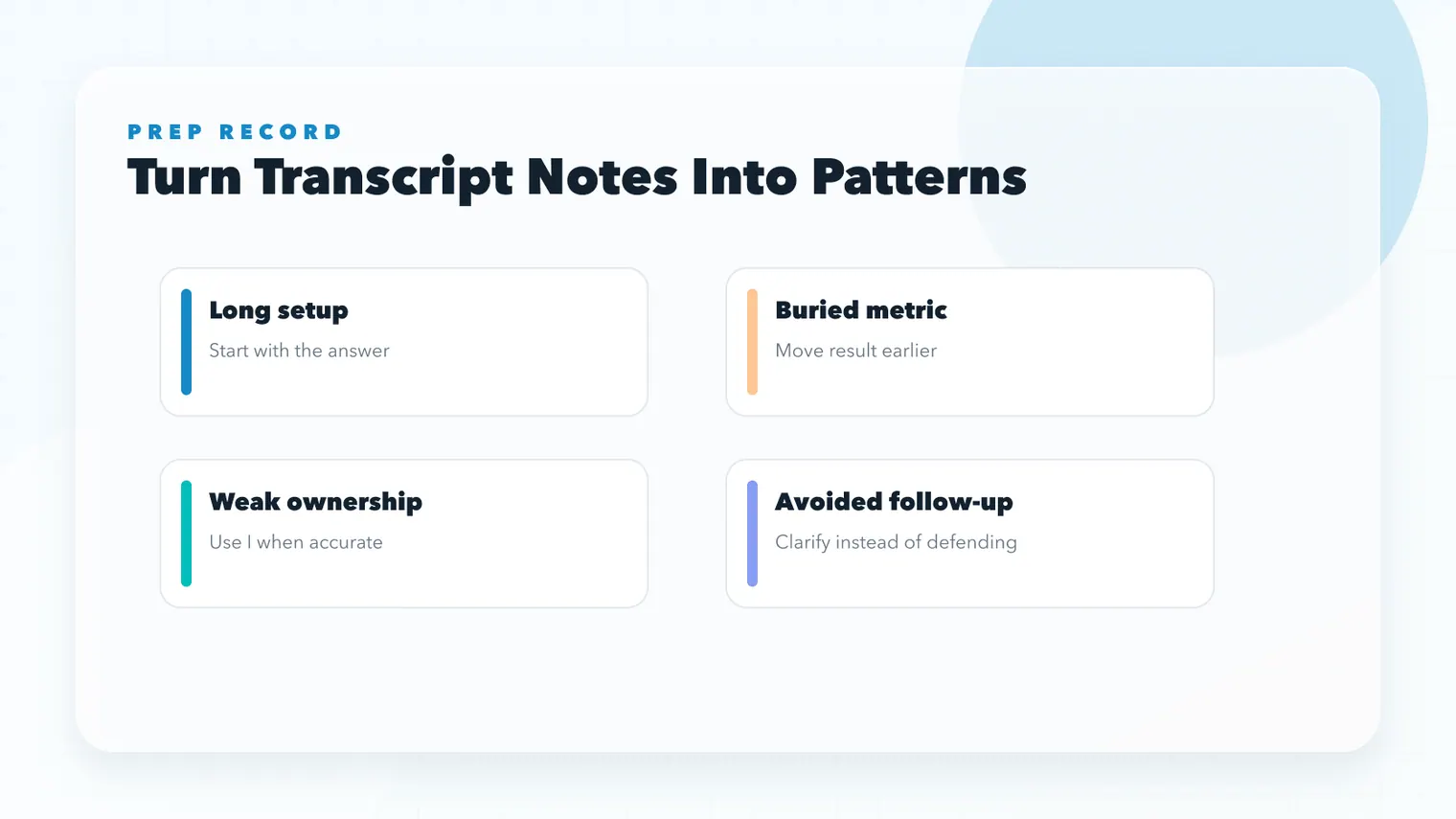
Turn transcripts into a reusable prep record
The best transcript habit is cumulative. Save the questions you practiced, the stories you used, the follow-ups you missed, and the revised answer notes. Over time, your preparation record becomes more useful than a generic question bank. It shows your actual weak patterns.
University of Colorado Boulder career guidance recommends reviewing recorded answers and getting input from others after practice. That advice fits transcript-based prep well because a transcript is easy to share, skim, and annotate.
This is also why the MockGPT product direction connects transcripts to feedback and future sessions. If you are preparing for several companies, your transcript history can show whether you keep over-explaining, missing metrics, or avoiding tradeoffs. That pattern is the coaching opportunity.
- The transcript has one highlighted sentence that directly answers the question.
- Ownership language is clear enough for someone who does not know the project.
- The result is visible before the answer ends.
- Follow-up gaps are marked separately from first-answer issues.
- Only one improvement target is chosen for the next repetition.
- The final notes are saved for the next interview round.
What an interview transcript cannot do
A transcript cannot tell the whole story. It does not fully capture tone, warmth, facial expression, or rapport. It may miss context if the speech-to-text quality is poor. It can also make normal spoken language look messier than it felt. Use it as a tool, not as a verdict.
Still, an interview transcript is one of the fastest ways to improve because it removes guesswork. You can see whether the answer was direct. You can see whether your best evidence appeared. You can see whether the follow-up exposed a weak point. Once you can see it, you can practice it.

Compare multiple transcripts to find patterns
One transcript reveals a moment. Several transcripts reveal a pattern. If every practice answer starts with a long setup, you have a sequencing habit. If every answer uses "we" but rarely says what you owned, you have an ownership habit. If your results are always vague, you may need to revisit your resume and collect better evidence before practicing more.
Do not compare transcripts by score only. Compare them by repeated issue. Make a simple tally: setup too long, ownership unclear, result missing, follow-up weak, role connection missing, delivery too rushed. After three or four practice answers, one or two patterns usually stand out. Those patterns should become the next practice plan.
This is where transcript review becomes more than editing. It becomes diagnosis. A single answer may have many imperfections, but a repeated pattern points to the highest-leverage fix. If you repeatedly bury results, practice result-first openings. If you repeatedly miss role relevance, practice ending every story with the role signal it proves.
Do not use transcripts to chase flawless wording. Use them to find the one repeated habit that weakens otherwise strong answers.
Use transcripts to improve your resume story
A transcript can expose a mismatch between your resume and your spoken evidence. Maybe your resume says you "led" a project, but your answer sounds like you mainly supported another owner. Maybe your resume lists a metric, but you cannot explain how that metric was measured. Maybe your resume uses a tool name, but your interview answer shows the business decision was more important.
When that happens, do not only fix the answer. Fix the resume story too. Your written materials and spoken examples should support each other. If a bullet creates a follow-up you cannot answer, revise the bullet or prepare the missing evidence. If your spoken story contains stronger detail than the resume, consider whether that detail belongs in a future resume version.
This is part of the broader interview practice loop: interview practice should feed resume improvement, not sit apart from it. The answer you can defend out loud is often the answer that deserves to be reflected in your application materials.
Review transcripts without becoming self-critical
Transcript review can feel uncomfortable because spoken language looks messy on the page. You may see false starts, repeated words, unfinished clauses, and filler. That does not mean the interview went badly. Human speech is not a polished article. The question is whether the listener could follow the answer and identify the evidence.
Use a two-color system. Mark structural issues in one color and harmless speech habits in another. Structural issues include missing results, unclear ownership, and unanswered questions. Harmless speech habits include small restarts that do not block meaning. Fix the structural issues first. Leave normal speech alone unless it distracts from clarity.
If you use AI-generated transcription, remember that transcripts can contain errors. Do not overreact to a strange word if the audio was clear. Use the transcript as a guide, and use replay when the wording seems suspicious. The goal is better interview communication, not perfect transcription hygiene.
Fix missing results, unclear ownership, and unanswered prompts first.
Leave normal speech restarts alone unless they block meaning.
Use audio or video when the transcript looks suspicious.
Connect transcript review to feedback
A transcript is evidence; feedback is interpretation. You need both. The transcript shows what happened. Feedback explains why it matters and what to do next. If feedback says your answer lacked relevance, the transcript should show where the role connection was missing. If feedback says your follow-up was weak, the transcript should show whether you repeated the first answer or answered the new question.
For a deeper product-led framework, start from the interview transcript and feedback loop. The strongest practice loop combines the two: transcript for proof, feedback for priority, and another practice round for behavior change.
Do not treat a transcript as an archive you save and ignore. Treat it as a working document. Highlight one issue, choose one revision, run one new answer, and compare. That loop is simple enough to repeat before every important round.
Use transcript snippets as reusable answer notes
After review, pull out only the useful snippets. A snippet might be a strong opening sentence, a clean metric explanation, a concise ownership line, or a better way to describe a tradeoff. Keep these snippets in your story bank. They are not scripts; they are anchors that help you remember the strongest version of the idea.
This is different from saving the whole transcript. A full transcript is too long to review before an interview. A small set of snippets is practical. Before the next round, you can skim the best ownership line for each story, the metric you want to remember, and the follow-up you previously missed.
Over time, this creates a personalized answer library. It is built from your real speech, not generic templates. That makes it easier to sound natural because the phrasing came from your own practice, then was tightened through review.
Save the one sentence that made the answer clearer. Do not turn the whole transcript into a script.
Decide what belongs in the next session
Transcript review should end with a practice decision. If the main issue was long setup, the next session should include a concise-opening drill. If the main issue was weak results, the next session should include metric recall. If the main issue was follow-up avoidance, the next session should include targeted probing.
Write the next drill at the top of your notes. Make it small enough to do in ten minutes. For example: "Answer the dashboard story in 75 seconds and name the result before the final sentence." That is better than "practice more." A narrow drill creates visible improvement.
When you return to MockGPT or any practice partner, use that drill as the session goal. A realistic mock interview is useful, but targeted practice between full sessions is what makes the next full session better.
Protect privacy when using transcripts
Interview practice can include sensitive information: company names, internal metrics, customer details, personal career history, and compensation context. When saving or sharing transcripts, remove details you do not need. Use placeholders for confidential company or customer names. Keep only the detail needed to improve the answer.
This is important for any tool, not only AI tools. A transcript is easier to search and copy than an audio memory. Treat it as a document that deserves care. If you ask another person for feedback, share the smallest useful excerpt rather than an entire session.
Privacy-conscious review also makes answers better. Replacing confidential details forces you to explain the business situation clearly without relying on names the interviewer will not know. That often improves the story for real interviews too.

Review transcripts for questions, not only answers
Candidates usually focus on their answers, but the questions matter too. Save the exact wording of prompts and follow-ups. Over time, you will notice which questions create hesitation. Maybe you struggle when questions ask about conflict. Maybe you struggle when a prompt asks for a metric. Maybe you struggle when the interviewer asks why you chose one option over another.
Those patterns help you practice smarter. Build a small prompt library from your own sessions. Keep the prompts that exposed weak spots, not only the ones you answered well. The next time you practice, start with those prompts. This keeps preparation grounded in real friction instead of generic lists.
Question review also helps after real interviews. If a real interviewer asks something that did not appear in practice, add it to the library. Then write what signal it was probably testing. Was it ownership, judgment, motivation, communication, or depth? That label will help you prepare a stronger answer before the next round.
Keep the questions that made you hesitate. They are better practice material than another generic list of easy prompts.
Do one clean replay after transcript edits
After you revise an answer from text, say it again out loud. Some edits look strong on the page but sound unnatural. The replay step checks whether the improvement still works as speech. If the revised answer feels too formal, simplify the wording while keeping the evidence.
This is the basic rhythm: raw answer, transcript review, small edit, clean replay. Do not skip the final replay. It turns analysis back into performance.
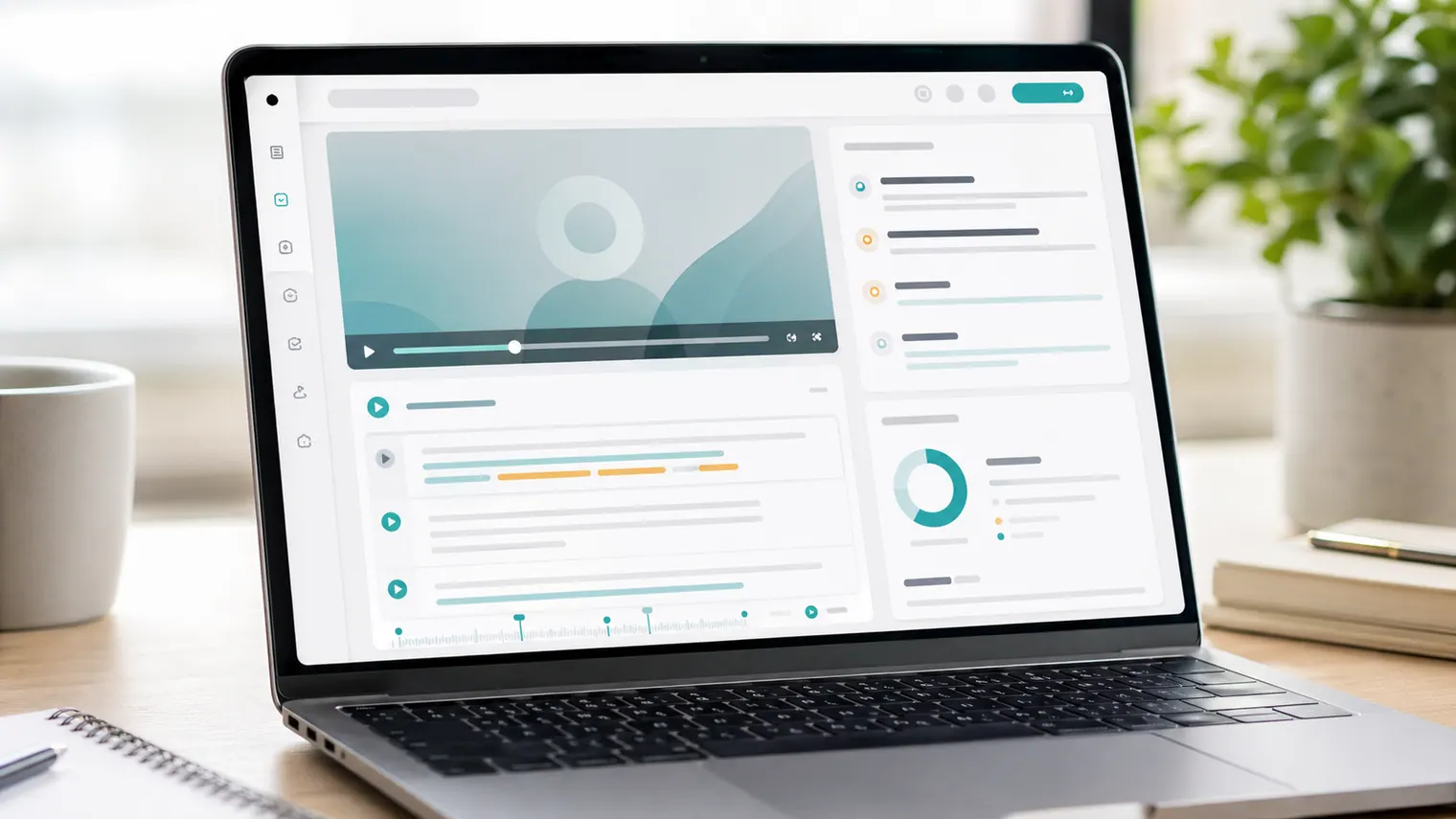
If the clean replay sounds better but still feels slightly awkward, keep the idea and loosen the phrasing. Candidates often improve fastest when they preserve the structure of a stronger answer but let the exact words change each time. That balance keeps the answer reliable without making it sound memorized.
Also check whether the revised answer still fits the original prompt. Editing can accidentally move the answer away from the question because the improved sentence sounds polished. The final replay should prove that the answer is both clearer and still responsive to what was asked.
If the replay passes that test, save only the short note you need for next time. The value is not the transcript file itself; it is the cleaner behavior you can repeat when the real interviewer is listening.
That is the moment review becomes practice. In MockGPT interview transcript review, that practice can become a repeatable interview habit you can trust under pressure in real interviews later.
FAQ: interview transcript review
Should I edit every transcript sentence?
No. Focus on structure, ownership, result, and follow-up gaps. Spoken answers should still sound natural.
How many transcripts should I review?
Review one or two focused practice answers at a time. More than that can create noise unless you are looking for repeated patterns.
What should I highlight first?
Highlight the sentence where you actually answer the question. If it is missing or buried, that is your first revision target.
How can MockGPT help with interview transcript review?
MockGPT can pair transcript review with resume- and role-specific practice, so you can find vague answers, buried results, and follow-up gaps before the real interview.