
Leadership interview questions are not only for people with manager titles, and MockGPT treats them as proof questions rather than personality labels. Hiring teams ask them when they need to know whether you can create trust, make decisions, guide other people, and stay useful when the work gets messy.
The weak answer usually sounds like a slogan: "I lead by example," "I am a team player," or "I communicate well." Those lines may be true, but they do not give the interviewer enough evidence. A stronger answer shows the situation, the judgment call, the people involved, and what changed because of your action.
Leadership interview answers have to close the gap between polished claims and real proof. If your resume or target job says leadership matters, your practice should test the stories behind that claim, not just help you memorize nicer wording.
If your answer does not show a decision, a people impact, and a result, it may sound confident without proving leadership.
What leadership interview questions really test
Good leadership interview questions test how you behave when other people depend on your judgment. The interviewer is not only listening for authority. They are listening for clarity, ownership, humility, conflict handling, coaching, and the ability to keep work moving without pretending everything was easy.
The U.S. Office of Personnel Management notes that structured interviews use job-related questions and consistent rating criteria. That matters for candidates because a leadership answer should make the signal easy to rate. Do not make the interviewer guess what you did or why it mattered.
NACE also treats leadership as a career readiness competency, not only a formal title. That is useful for early-career candidates, career changers, and individual contributors. You can show leadership through influence, problem solving, mentoring, coordination, or decision quality.
12 leadership interview questions to practice first
Start with prompts that force a real story. These leadership interview questions are common because they reveal whether you can explain people, stakes, choices, and outcomes without hiding behind buzzwords.
Leadership question map
What each prompt is usually testing under the surface| Question | What it tests | Evidence to prepare |
|---|---|---|
| Tell me about a time you led a team through a hard problem. | Direction setting and ownership. | The problem, your decision, and the result. |
| Describe a time you had to influence someone without authority. | Persuasion and trust building. | What the person cared about and how you changed the conversation. |
| Tell me about a conflict you helped resolve. | Emotional control and fairness. | Both sides, the tradeoff, and the working agreement. |
| Give an example of coaching or mentoring someone. | People development. | The person's starting point and what improved. |
| Tell me about a time you made an unpopular decision. | Judgment under pressure. | Why you chose it and how you handled resistance. |
| Describe a leadership mistake you made. | Self-awareness and learning. | What you missed, what changed, and how you act now. |
| How do you keep a team aligned when priorities change? | Communication and planning. | The system you used to reset expectations. |
| Tell me about a time you improved a process. | Initiative and operational thinking. | The friction, the change, and the measurable effect. |
| How do you handle underperformance? | Directness and care. | The standard, the conversation, and the follow-up. |
| Describe a time you protected quality under a deadline. | Prioritization and risk judgment. | What you cut, what you kept, and why. |
| How do you make sure quieter teammates are heard? | Inclusion and meeting design. | The habit or format that changed participation. |
| What kind of leader are you? | Leadership philosophy backed by proof. | One clear sentence plus one story that proves it. |
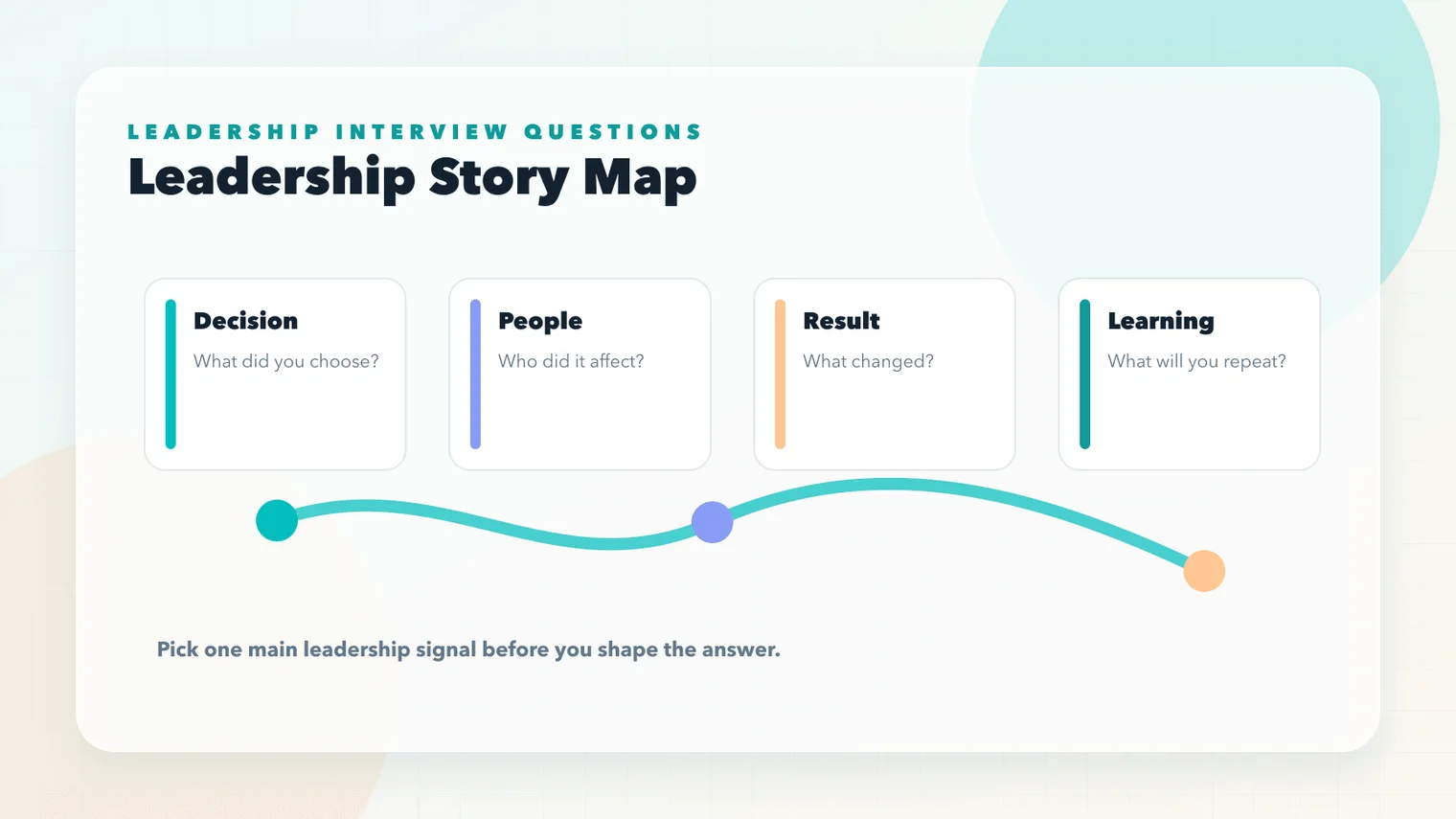
- DecisionWhat did you choose when there was no perfect option?
- PeopleWho was affected, and how did you bring them along?
- ResultWhat changed after your leadership became visible?
Build a story map before writing answers
Most candidates prepare leadership interview questions and answers one answer at a time. That creates a problem. You may end up forcing the same story into every prompt, even when the question is testing something different.
A better approach is to build a small story map. Choose five or six stories from your resume, projects, volunteering, school, or team work. Then label each story by the leadership signal it proves. One story might show influence without authority. Another might show coaching. Another might show a hard tradeoff.
Use one story for one main signal
A story can contain many details, but your answer should have one main job. If the question asks about conflict, do not spend most of the answer proving you worked hard. If the question asks about influence, do not make the answer only about your task list. Choose the signal first, then trim the story around it.
This is also how you avoid sounding rehearsed. You are not memorizing a full script. You are learning which evidence belongs to which leadership signal, so you can adapt when the interviewer changes the wording.
Show how you changed a decision, not only how you shared an opinion.
Show the real tension and how you protected the work relationship.
Show the person's growth, not only that you were helpful.
Show what you gave up and why the choice was responsible.
Answer leadership interview questions with judgment, not slogans
The easiest leadership answer structure is not a rigid script. It is a judgment path: context, decision, action, result, learning. Context explains why the situation mattered. Decision shows leadership. Action shows what you personally did. Result proves the work changed. Learning shows maturity.
For example, do not start with, "I am a collaborative leader." Start with the moment. "Our launch scope changed two weeks before release, and two teams disagreed on what to cut." That first sentence gives the interviewer something real to evaluate.
Then name your decision. "I asked the teams to separate must-have customer risks from nice-to-have improvements, then proposed a smaller launch list with one clear owner for each risk." Now the answer has leadership behavior, not just leadership language.
- Open with the problem and why it mattered.
- Name the leadership decision you made.
- Explain how you brought people with you.
- Share the result, metric, or concrete change.
- End with what you would repeat or change next time.
Keep the answer grounded in your actual role
One danger with leadership interview questions is overclaiming. If you were not the manager, say that. You can still show leadership through ownership, influence, facilitation, mentoring, escalation, or process improvement. Inflating your title makes follow-up questions harder.
A strong individual contributor answer might say, "I was not the project lead, but I noticed the handoff problem and organized the first shared tracker." That is believable. It shows initiative without pretending you had authority you did not have.
Prepare for follow-up questions that test depth
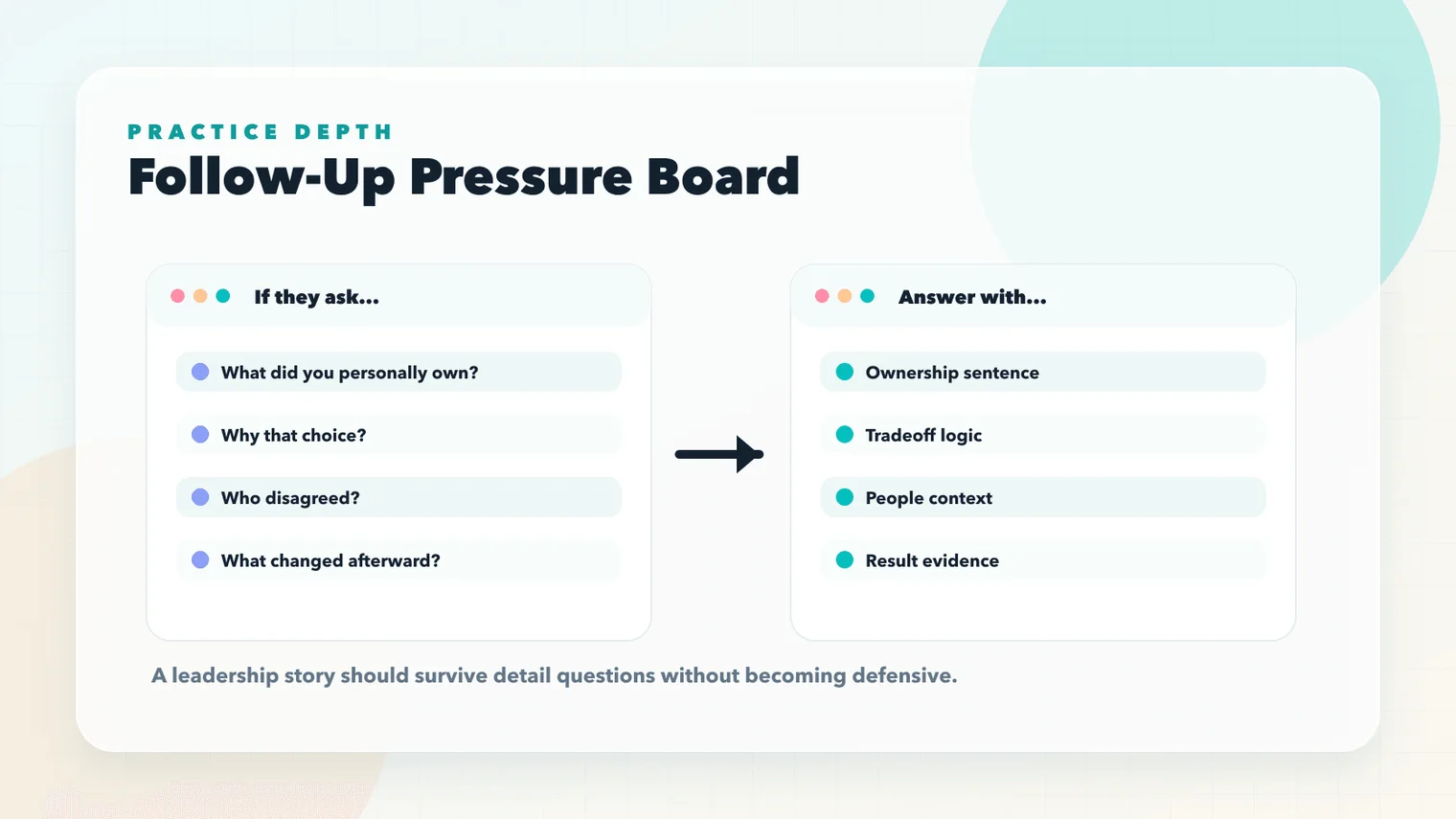
The first answer is only the surface. Interviewers often use follow-up questions to see whether the story is real. They may ask what you personally owned, what the other person thought, what you would do differently, how you measured success, or why you chose one option over another.
This is where many leadership answers fall apart. The headline story sounds good, but the details are thin. If you cannot answer the follow-up, the interviewer may wonder whether the story was polished after the fact.
Follow-up pressure test
Questions to ask yourself before the real interview| Follow-up | Weak answer risk | What to prepare |
|---|---|---|
| What did you personally do? | The story sounds like a team achievement with no ownership. | One sentence that separates your role from the group's work. |
| Why did you choose that approach? | The decision sounds accidental. | The options you considered and the reason for the choice. |
| How did the other person respond? | The people side sounds too neat. | The resistance, concern, or emotion you had to handle. |
| What would you do differently? | The answer sounds defensive. | One honest improvement that does not erase the result. |
Weak and strong leadership answer patterns
Weak leadership answers usually stay at the personality level. They describe the candidate as positive, supportive, passionate, hands-on, or calm. Those traits may be useful, but they are not enough unless the answer shows behavior.
Strong answers move from trait to evidence. Instead of saying, "I am a good communicator," say how you clarified the plan, who needed alignment, what changed after the update, and how you knew the team understood the next step.
Here is a simple before and after. Weak: "I led a team project and made sure everyone stayed motivated." Stronger: "When our timeline moved up by two weeks, I split the work into three risk groups, asked each owner to name one blocker, and reset the scope so we could ship the customer-critical pieces on time."
Replace the leadership adjective with the behavior that proved it. Then add the result.
Turn leadership interview questions into a practice plan
Do not try to practice every prompt about leadership in one sitting. Choose three high-risk signals for your target job. A team lead role may need conflict, coaching, and prioritization. A product role may need influence, tradeoffs, and cross-functional alignment. A senior individual contributor role may need ownership, mentoring, and judgment under ambiguity.
After each practice answer, review what you actually said. Strong leadership stories for interviews make the result, decision, people tension, and actual role visible. Those are fixable problems, but only if you catch them before the real interview.
This is the preparation loop MockGPT is meant to support: connect the role to the right leadership signals, practice realistic follow-ups, review the transcript, and choose the next answer to improve. Leadership is easier to believe when the story can survive questions.
FAQ: leadership interview questions
What are leadership interview questions?
Leadership interview questions ask for examples of decision making, influence, conflict handling, coaching, ownership, and results. They test how you behave when other people depend on your judgment.
How should I answer leadership interview questions?
Use a real story. Start with the problem, name the decision you made, explain how you worked with people, share the result, and end with what you learned or changed afterward.
Can I answer leadership questions if I was not a manager?
Yes. You can show leadership through influence, ownership, mentoring, coordination, process improvement, and good judgment. Be honest about your role and focus on the behavior you actually owned.
How can MockGPT help with leadership interview practice?
MockGPT can turn your resume and target role into leadership follow-ups, then help you review whether each answer shows decision making, influence, and results without sounding inflated.