If you searched for what to bring to an interview, the answer is not "carry everything that might make you look prepared." Bring the materials that help you answer clearly, prove your fit, handle logistics, and take useful notes afterward. MockGPT is being built around the same preparation loop: resume context, job-description context, realistic follow-ups, review, and a sharper next drill.
That matters because candidates often bring the wrong kind of preparation. They print a resume, pack a notebook, then rely on a long script in their head. A good interview kit is smaller: resume copies, a role-specific prep sheet, a few questions, logistics, and backups for the format you are walking into.
Use this guide as a practical checklist for what to bring to an interview in person, on video, or by phone, and what to leave out so your preparation does not become noise.
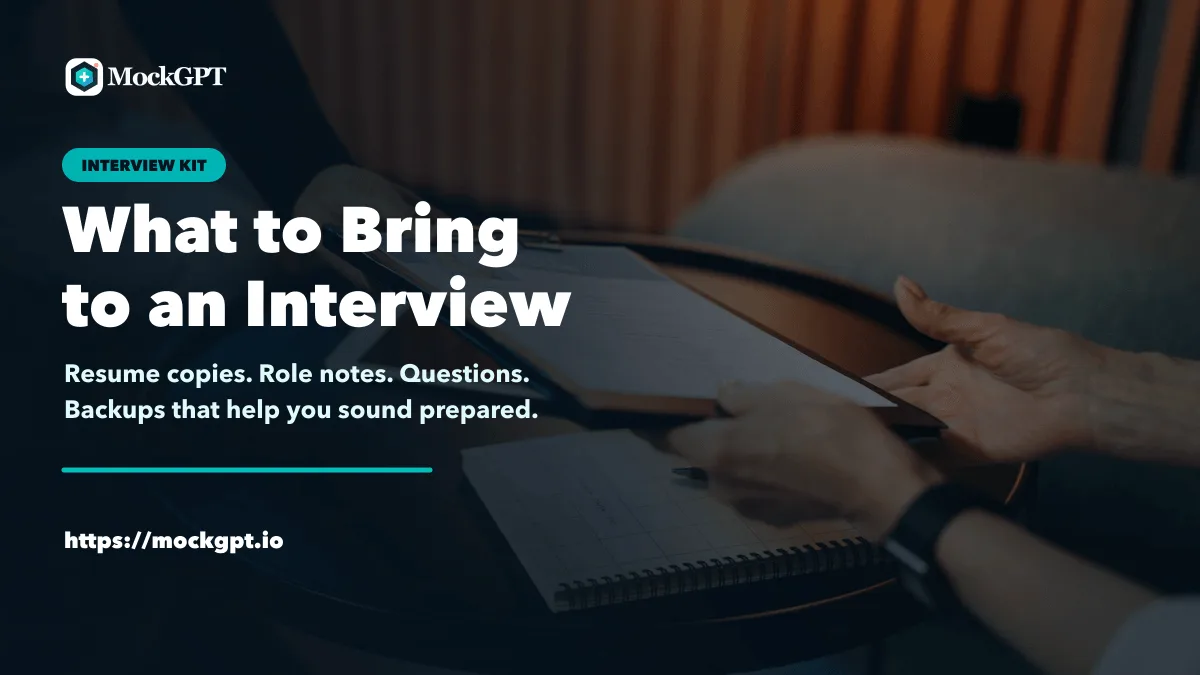
Bring proof, prompts, and backups: your resume, job-specific notes, questions for the interviewer, logistics, ID if needed, a notebook, a working pen, and any portfolio or work samples the role naturally requires.
What to bring to an interview: quick checklist
The best answer to what to bring to an interview depends on the round, but most candidates need the same core set. Keep it lean enough that you can find everything in seconds.
Interview kit
Bring items that support clear answers, not clutter| Item | Why it helps | Keep it simple |
|---|---|---|
| Resume copies | Gives every interviewer the same version and helps you reference exact details. | Two to five clean copies in a folder. |
| Job description notes | Reminds you which role signals matter most. | One page with top requirements and matching stories. |
| Questions to ask | Shows judgment and helps you evaluate the role. | Three to five questions, not a long script. |
| Portfolio or samples | Supports roles where work output matters. | Only bring samples you can explain in under two minutes. |
| Notebook and pen | Lets you capture names, priorities, and follow-up details. | Use notes lightly; do not write during every answer. |
| Logistics | Prevents avoidable stress. | Address, contact name, schedule, ID, and backup contact. |
Think of the checklist in three categories: materials the interviewer may ask to see, notes that help you answer, and backups that prevent small problems from taking over the conversation.
Bring the exact resume version they have
The first thing to bring to an interview is the resume version you submitted for that job. Not the latest draft, not a different layout, and not the version you wish you had sent. The interviewer may ask about a bullet, date, metric, project, or skill from the version in their system.
Bring at least two clean copies for a one-on-one conversation. Bring more for a panel or onsite round. Even when the company says they have your resume, a paper copy can save the moment if an interviewer joins late, a printer fails, or someone wants to mark up a detail.
The resume is not only a courtesy. It is also a map for your answers. Before the interview, circle the three bullets most likely to come up. Next to each one, write the story you want to tell, the result you can prove, and the follow-up that might expose weak detail. This is where what to bring to an interview becomes answer preparation, not just packing.
If you are interviewing virtually, keep the same resume PDF open in a separate window or printed beside you. Do not rely on memory if a recruiter asks, "Can you walk me through this project?"
Bring a one-page job description scorecard
Most candidates bring their resume and forget the job description. That is backward. The job description tells you what the employer is trying to verify. It names the tools, responsibilities, stakeholders, seniority, and success signals you need to connect to your experience.
Create a one-page scorecard before the interview:
- Five requirements that repeat or appear near the top of the job description.
- One resume-backed story for each requirement.
- One gap or risk you may need to explain calmly.
- Two numbers, outcomes, or decisions that make your experience concrete.
- One reason this role is the next logical step.
This scorecard is not something to read word for word. It is a prep tool. If the interviewer asks a broad question, you can choose the story that proves the most relevant signal. If they ask a follow-up, you can return to evidence instead of reaching for a memorized line.
University career offices often advise candidates to research the role, practice examples, and prepare questions before an interview. Georgetown University's general interview guide is a useful baseline here because it treats preparation as both research and practice, not just appearance.
If your prep sheet is longer than one page, it will probably become a distraction. The goal is to remember the signal, not carry a private textbook into the room.
Bring a small story bank, not a script
When people ask what to bring to an interview, they usually think of physical items. The more important thing to bring is a set of flexible stories. A strong story can answer several prompts: conflict, leadership, failure, initiative, ambiguity, customer pressure, or learning curve.
Prepare five story cards. Each card should have:
- A short title you can recognize quickly.
- The role signal it proves.
- The situation in one sentence.
- Your action, not the team's generic action.
- The result or lesson.
- One follow-up detail you might need.
Do not write paragraphs. Write cues. A story card should help you start in the right place, not trap you into reciting. MIT's STAR method guidance is useful because it keeps examples organized around situation, task, action, and result. The missing piece is pressure: your story should also survive one or two follow-up questions.
This is a good place to use interview preparation materials intentionally. If a story cannot connect to the job description, it may be a good story but the wrong interview story.

Bring questions that test the role, not just the company
Questions for the interviewer belong on the list of what to bring to an interview because they affect both sides of the decision. They show how you think, and they help you understand whether the role fits.
Bring three types:
What does success look like in the first 90 days?
How does this team make tradeoff decisions?
What usually makes someone struggle in this role?
Avoid questions you can answer from the careers page in thirty seconds. Also avoid making every question about benefits, flexibility, salary, or promotion timing in the first conversation. Those topics matter, but the interview should first show that you understand the work.
If the conversation already covered your question, do not ask it anyway. Say, "You answered my question about the first 90 days earlier. I have one follow-up: what would you want the new hire to fix first?" That sounds more present than reading a list.
Bring a portfolio only if it helps the interviewer judge the work
A portfolio, project sample, GitHub link, case study, writing sample, campaign result, design artifact, or analysis deck can help when the role depends on visible output. It can hurt when it feels unrelated or confidential.
Bring a portfolio when:
- The job posting asks for samples.
- Your field commonly reviews work artifacts.
- The sample proves a skill your resume only mentions.
- You can explain context, constraints, tradeoffs, and result quickly.
Do not bring private client data, internal documents, code you cannot share, or anything that makes the interviewer wonder about your judgment. If you need to discuss sensitive work, prepare a sanitized version: problem type, your role, decision, and measurable result without exposing names or confidential details.
For product, design, data, marketing, engineering, or operations roles, the best sample is usually not the prettiest artifact. It is the one you can explain under follow-up pressure. What changed? What did you own? What would you do differently? Why did the tradeoff make sense?
What to bring to a video or phone interview
For remote rounds, what to bring to an interview changes shape. Your "bag" becomes your desktop, room, browser tabs, backup plan, and notes.
Bring or prepare:
- The meeting link copied into your calendar and a backup note.
- A charged laptop and charger.
- Headphones or a tested microphone.
- Your resume PDF and one-page scorecard.
- A clean desktop with unrelated tabs closed.
- A glass of water.
- A backup phone number or recruiter email.
Do not put a full script on the screen. Interviewers can often tell when your eyes are tracking text. Use short cues instead: story titles, metrics, questions, and names. If you need notes, place them near the camera so you do not look away for long.
For phone interviews, keep a quiet space, charged phone, headphones, resume, and notes. Because the interviewer cannot see your face, your answers need cleaner signposting. Start with the direct answer, pause, and then give the example.
What not to bring to an interview
The wrong items can make preparation look scattered. Leave out anything that creates distraction, risk, or dependency.
Leave it out
Preparation should reduce noise| Do not bring | Why it hurts | Bring instead |
|---|---|---|
| A long answer script | You may sound memorized or lose your place. | Story cues and role signals. |
| Confidential work files | It raises trust and privacy concerns. | Sanitized summaries. |
| Too many papers | You waste time searching for the right detail. | One folder with labeled sections. |
| Unrelated portfolio pieces | They weaken the role-fit signal. | Two or three targeted samples. |
| Visible personal distractions | They pull attention away from the conversation. | A quiet, focused setup. |
The real test is simple: does this item help the interviewer understand why you fit this job? If not, leave it out.
How to organize everything before you leave
If you are going onsite, use one slim folder or portfolio. Put resume copies first, then the job description scorecard, then questions, then work samples. Keep ID, parking details, building access instructions, and contact information where you can reach them without digging.
If the interview is virtual, organize your digital space the same way. Use one folder or desktop area with the resume PDF, scorecard, portfolio link, and questions. Close anything unrelated. Test your camera, audio, and meeting link early enough to fix problems without panic.
Then do one spoken run-through. Do not rehearse the whole interview. Practice the first answer, one story, and one follow-up. That is enough to check whether your notes help or whether they pull you into reading.
This is the practical value of what should I bring to an interview as a preparation question. The item list is only useful if it improves the conversation.
Use the same kit after the interview
The materials you bring should also help after the interview. Right after the call or onsite round, write down the interviewer's names, the questions that surprised you, the stories that landed, and the follow-ups that felt weak.
Do this while the details are fresh:
- Which answer was strongest?
- Which answer became too long?
- Which follow-up exposed missing detail?
- What did the interviewer emphasize about the role?
- What should you practice before the next round?
Those notes are not just for a thank-you email. They are input for your next practice loop. If the next round is with a hiring manager, you may need deeper project detail. If it is a panel, you may need clearer signposting. If it is a final round, you may need stronger judgment stories.
Final check before the interview
The final answer to what to bring to an interview is less about owning the perfect bag and more about removing avoidable friction. Bring what helps you prove fit, stay calm, and listen well. Leave out anything that tempts you to read, perform, or over-explain.
Before you leave or join the call, ask:
- Do I have the resume version they have?
- Can I name the top role signals?
- Do I have three to five flexible stories?
- Do I have questions that reveal the actual work?
- Have I tested the logistics?
- Do I know what to review afterward?
If that checklist is done, stop adding materials. Use the time to practice one answer out loud. MockGPT can fit into that last step by helping candidates think in terms of role context, realistic follow-ups, review, feedback, and a clearer next practice plan instead of carrying a script into the interview.
What to bring to an interview FAQ
What should I bring to a job interview?
Bring clean resume copies, a one-page job description scorecard, three to five questions, a notebook, a pen, logistics, ID if required, and any role-relevant portfolio or work sample. Keep the kit small so it supports the conversation instead of distracting from it.
Should I bring a resume if the interviewer already has it?
Yes. Bring the exact resume version you submitted. It helps if an interviewer joins without a copy, wants to mark up a detail, or asks about a specific bullet. For a panel or onsite round, bring several copies.
What should I bring to a virtual interview?
For a virtual interview, prepare the meeting link, charged laptop, charger, tested audio, quiet room, resume PDF, one-page notes, a glass of water, and backup contact information. Close unrelated tabs and use short cues instead of a full script.
How can MockGPT help me prepare what to bring to an interview?
MockGPT is designed around the preparation loop behind the checklist: use your resume and job description as context, practice realistic follow-up pressure, review what happened, and turn feedback into the next practice plan.